University of Idaho partners with logging industry stakeholders to develop simulator-based education and outreach to secure a future workforce and improved public perception of commercial forestry.
— Dr. Ryer Becker
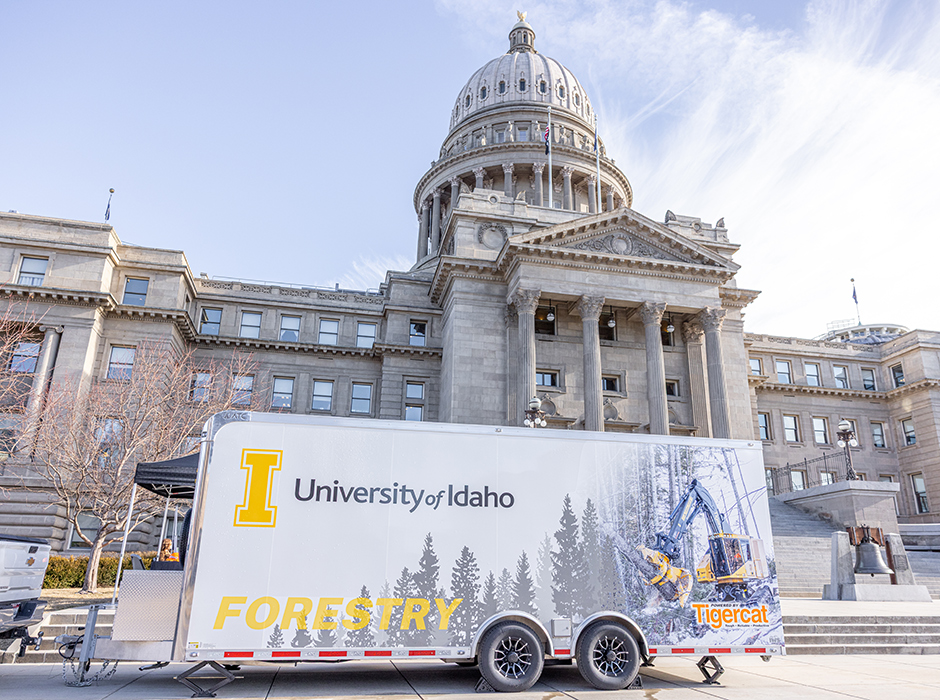
In February 2025, the University’s simulator trailer was set up in front of the Idaho State Capitol Building to provide the public, lawmakers, and their staff an opportunity to try simulators during Loggers and Haulers Days organized by the Associated Logging Contractors – Idaho.
The growing need to address workforce capacity in the logging industry necessitates the development of innovative and non-traditional methods for education, recruitment, and training. Regulatory, economic and cultural changes have created an environment where recruiting and retaining employees has become increasingly difficult for logging businesses. Despite advancing technology and increased mechanization ushering in safer and more productive operations, many company owners have been unable to consistently meet their workforce needs for skilled operators. Struggles with self-promotion, advocacy, and recruiting coupled with skewed public perceptions, or a fundamental unfamiliarity with the forest industry, hinders efforts to attract the required workforce.
A key strategy to addressing these needs is the development and delivery of innovative and impactful educational and recruitment efforts. Ensuring a vibrant and well-trained logging workforce begins with engaging the next generation and educating them on career paths in our forest products industry. With this comes a need to champion the industry and highlight the advancements made in recent decades surrounding safety, technology, and forest sustainability. Successfully doing so also promotes positive public perceptions surrounding logging and the forest products industry.
While workforce challenges in the forest products industry have a global impact, they are of particular concern in areas where the timber industry is a significant contributor to economies, and failure to successfully manage forestlands has economic, social, cultural, and biological ramifications. In Idaho, the forest products sector adds $2.8 billion and 30,000 jobs to the state’s economy annually. Given the significant value of the timber industry, the University of Idaho has partnered with state, private, and federal stakeholders on new training, outreach and educational efforts aimed at enhancing forest industry-based workforce capacities in Idaho and beyond. These new initiatives complement existing degree programs while adding training pathways related to logging and forest operations.
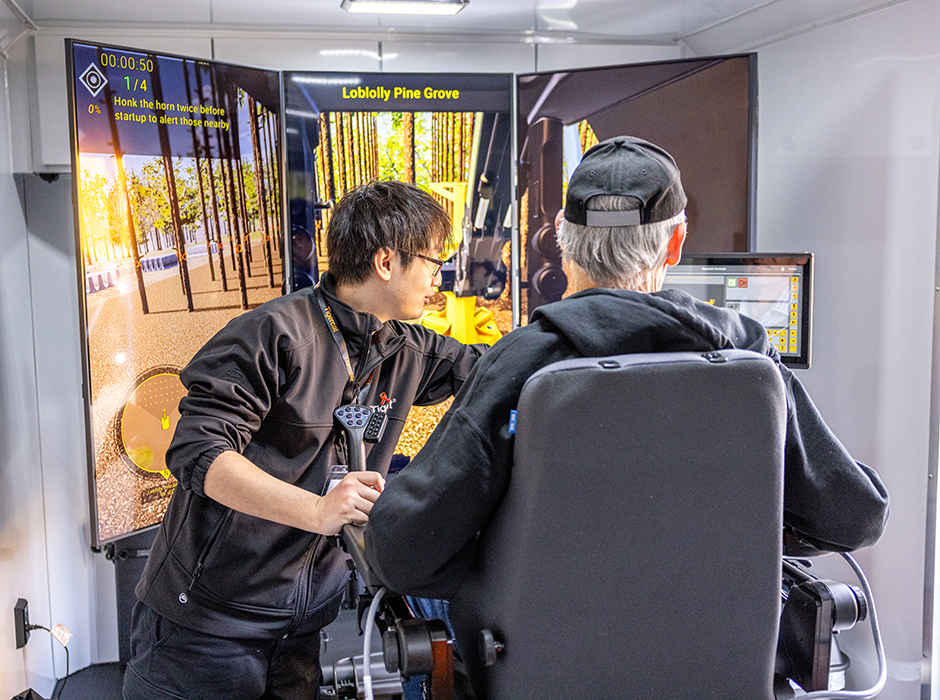
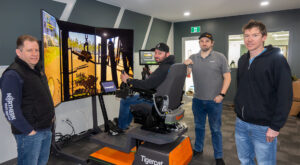
With prompted, step-by-step training exercises, Tigercat-TCi simulators provide a valuable training platform for beginners and more experienced operators alike.
It is ideal to incorporate experiential learning and hands-on training into outreach activities. However, this is challenging in logging due to the high capital cost and inherent risk associated with heavy equipment operation. Fortunately, advanced logging equipment simulator offerings from Tigercat Industries and others make outreach and training easier than ever.
In early 2025, Tigercat Industries and other key stakeholders in the forest products industry partnered with the University of Idaho to mobilize a custom logging simulator trailer. Other project partners who supported the initial project launch included Idaho Workforce Development Council, Green Diamond Resource Company, Jesse Hunt Logging, JEM Forestry, Nelson Brothers Timber Management, and Associated Logging Contractors – Idaho. The self-contained teaching and training trailer is the second in the University of Idaho College of Natural Resources’ fleet and the first to showcase two Tigercat-TCi equipment simulators.
The trailer was unveiled at the 2025 Oregon Logging Conference in mid-February. Since then, it has supported nearly twenty events in Idaho, Washington, and Oregon with over 800 participants. Some events supported training, while others focused on introducing participants to contemporary logging operations. The events also provide an opportunity for the University of Idaho team to highlight logging career pathways and the benefits the timber industry brings society through active forest management. The ability to bring this trailer-based simulator technology directly to diverse audiences throughout the western US maximizes accessibility to those who have historically lacked exposure to the logging industry.
Simulators offer an environment to introduce equipment operation and mechanized logging independent of safety concerns, costly repairs, or lost production, while providing a powerful hook to engage youth or adult audiences. Further, the Tigercat-TCi simulator provides opportunities for training and professional development with built-in training exercises to track progress and ensure competency benchmarks are met. From control familiarization to a progression through increasingly more advanced machine manipulations, the training exercises integrated into the Tigercat-TCi simulators prompt and guide operators as they hone skills and build fundamental competencies. These progressing exercises take trainees through varying topographies, forest types, and common operational tasks. Weather, including rain, snow, wind, fog, and varying levels of daylight can be adjusted to introduce additional environmental challenges. These settings can be quickly changed on the fly through the touchscreen interface.
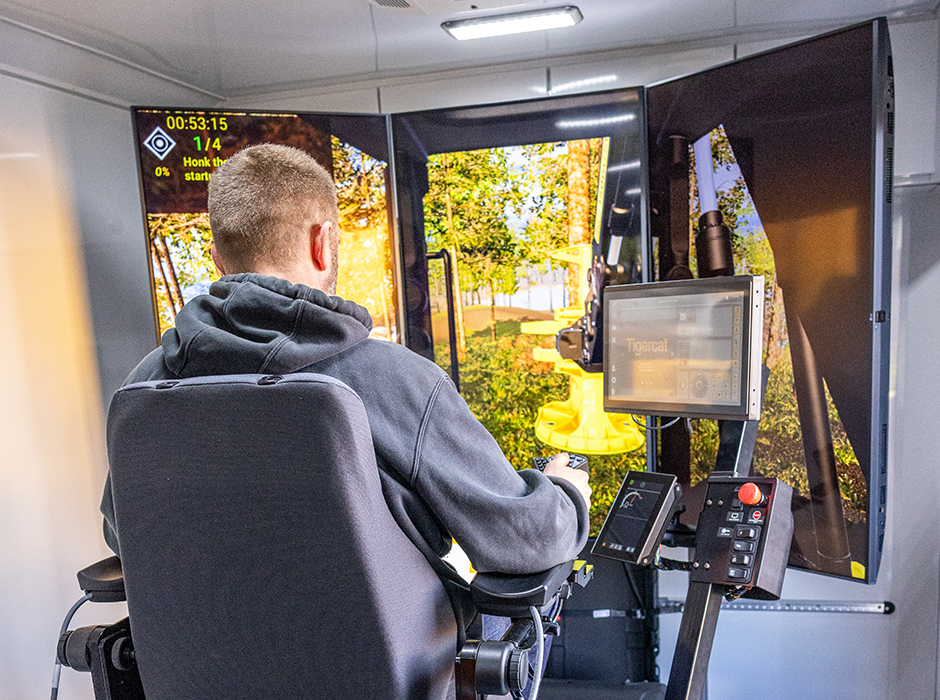
The Tigercat-TCi full-motion base simulators currently provide five equipment training options: feller buncher, roadside processor, rubber-tired skidder, wheeled harvester and forwarder. Transitioning between equipment and its associated training exercises can be done quickly through the user control interface touchscreen. When selecting between equipment, a carrier is first selected followed by the desired attachment and the training environment. OEM controls are matched to the machine and easily swapped out. The Tigercat Industries simulator design team has sought feedback, demonstrating the company’s desire to offer the most impactful and realistic training aid possible.
The Tigercat-TCi simulators provide a teaching and training experience with OEM control interfaces and three 55 inch screens for an immersive user experience.
It should be noted that simulators are not meant as a replacement for live, in-the-seat training, but as a complement to field-based instruction. However, the intentional design and OEM configuration of the Tigercat-TCi simulators prove invaluable for training applications. Button mapping and adjustable simulated valve controls provide an unmatched level of customization and configurability. The ability to quickly and easily map button layouts and change pressure ramping for machine controls allows for targeted training in situations where a trainee is being prepared to operate an existing machine in the field.
To date, the Tigercat-TCi logging equipment simulators have been used for outreach and education at career exploration events, logging conferences, public engagement events, career and technical education competitions, and more. While education and outreach have proven to be a great opportunity to leverage this resource, operator training remains another critical application. Workforce development and industry training remain top priorities for the University of Idaho through various pathways including four-year forestry degrees, a two-year degree in Forest Operations and Technology, and additional logger training offerings currently in development.
To support these pathways and the active, sustainable management of the nearly 10,000-acre (4 050 hectare) University of Idaho Experimental Forest (UIEF), the University of Idaho currently operates a student-run mechanized logging crew. Recent investments in full mechanization (feller buncher, grapple skidder and processor) support unique educational and training opportunities not readily available elsewhere in the United States. Access to cutting-edge equipment simulator technologies provides a complementary training platform to support existing workforce development pathways.
Still in the first year of integration into current educational and workforce development programming, the Tigercat-TCi logging simulators and associated custom training trailer are well on their way to providing critical resources needed to help educate, engage, and train the future logging workforce. Trailer mounting and transporting the simulators supports widespread use. In addition to supporting degree programs at the University of Idaho, the simulators have been made available to Career and Technical Education (CTE) programs and schools throughout Idaho. Where possible, support for other programs elsewhere in the western US will be considered. The simulators will also continue to be made available at regional logging conferences in the western United States.
Find out more
Requests for other training efforts and events can be made to Dr. Ryer Becker with the University of Idaho and will be supported where feasible. Logging contractors interested in leveraging these resources for training support should also contact Dr. Becker to discuss opportunities as this is an area of particular interest. As training program development continues, the vision is to also provide modularized simulator-based workshops to support introductory operator training, though there is no definitive timeline for when these will be made available to the public.
Any further questions related to this simulator trailer, requesting simulator support, or other information related to workforce development efforts underway at the University of Idaho College of Natural Resources can be directed to:
Dr. Ryer Becker, Forest Operations and Products Manufacturing Extension Specialist; Assistant Professor of Forest Operations at: rbecker@uidaho.edu
Keep your fleet of machines producing at full capacity while you train new operators virtually. The Tigercat Simulator provides a virtual operator training solution with an ultra-realistic operating environment. The advanced system is capable of simulating the controls and operation of several Tigercat machines including a track feller buncher, roadside processor, forwarder, or harvester.
In early March Irfan Zardadkhan and Gregor Scott from the Tigercat electronic systems group, and district manager James Farquhar travelled to the remote community of La Crete, Alberta. Their mission was a Tigercat simulator start-up.