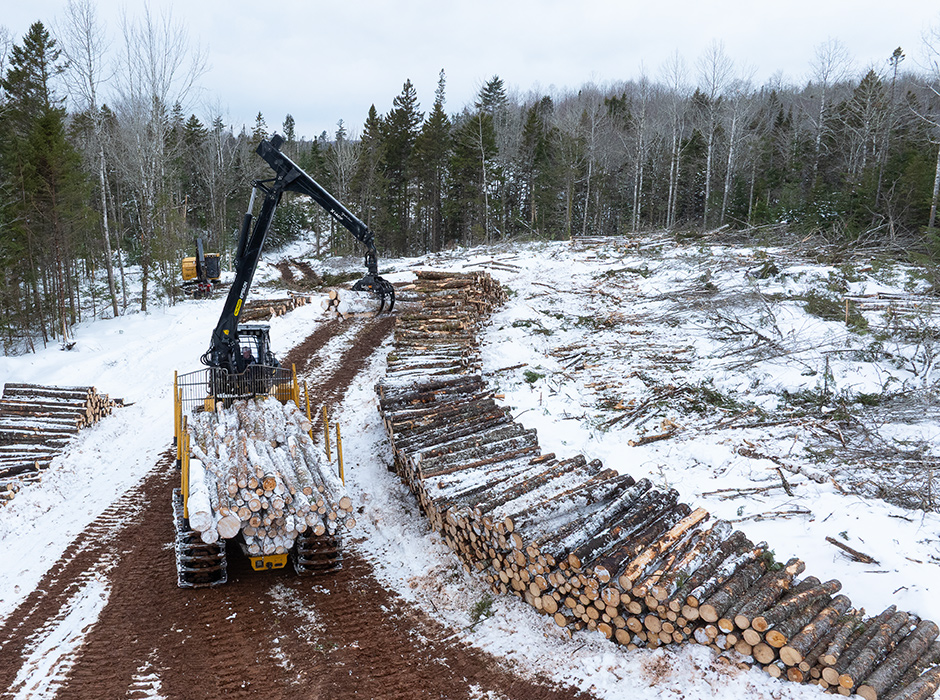
Shawn MacPhee’s harvesting system is built around Tigercat’s 845 platform and now includes a 1055D forwarder. Cost-effectively harvesting small diameter timber on shrinking blocks, means deploying machines with a flexible approach.
— Paul Iarocci
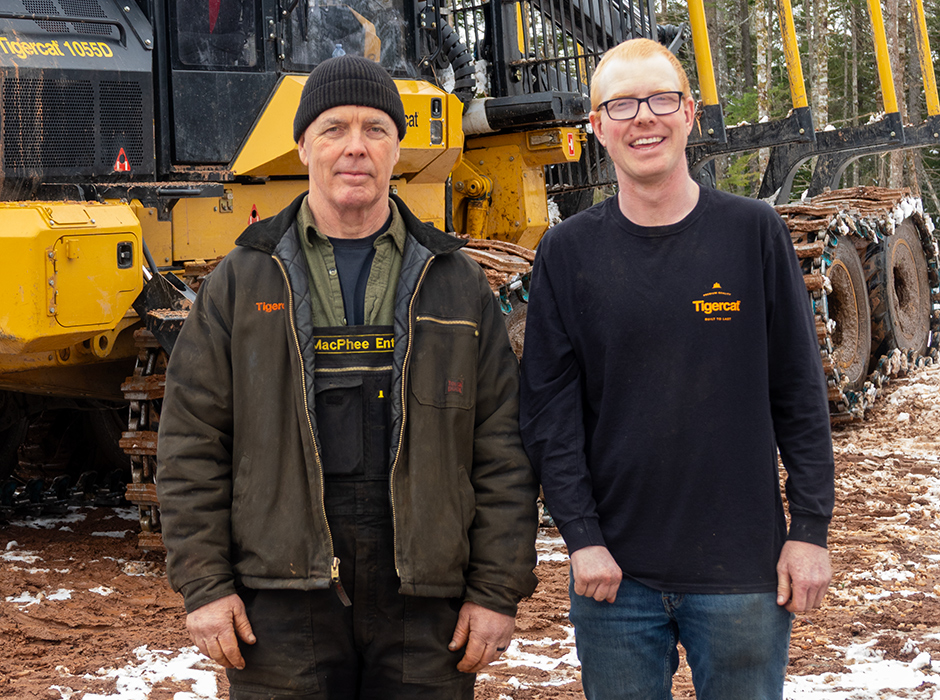
Shawn and Nathan MacPhee.
Shawn MacPhee, owner of Shawn MacPhee Enterprises Limited, describes the origin of his Nova Scotia company succinctly. “I started mechanic work, moved into trucking, and started logging in 1997.” In the early years, Shawn ran several sets of wheel harvesters and forwarders. Initially the company hauled to Bowater Mersey Paper Company. When it ceased operations in 2012, Shawn pivoted to other mills and markets.
Around 2004, he purchased his first secondhand Tigercat 845 series harvester, marking the start of his transition from wheel harvesters to track carriers. These days, Shawn’s harvesting system is built around the 845 platform. In 2014, Shawn purchased a new H845C from the Wajax, Dartmouth branch. Since then, Wajax Sales Specialist Sandy Hodgson has handled the bulk of Shawn’s new equipment needs.
Shawn laments that the 845 platform has been discontinued, stating that for the type of wood and conditions he is normally up against, it is the perfect sized machine, doing the job at a lower operating cost than larger carriers. He says that it is more convenient to float from site to site. He appreciates the long lifespan of the lighter weight F8 undercarriage, and lower costs associated with redoing the undercarriage. It burns less fuel than larger machines, reducing operating costs. It has all the swing torque required for the terrain conditions and tree size. Shawn asserts that for the wood that he typically encounters, there isn't another machine that could cost effectively produce more volume. He says that, especially when harvesting at the stump, the ER boom is a great benefit to the operator.
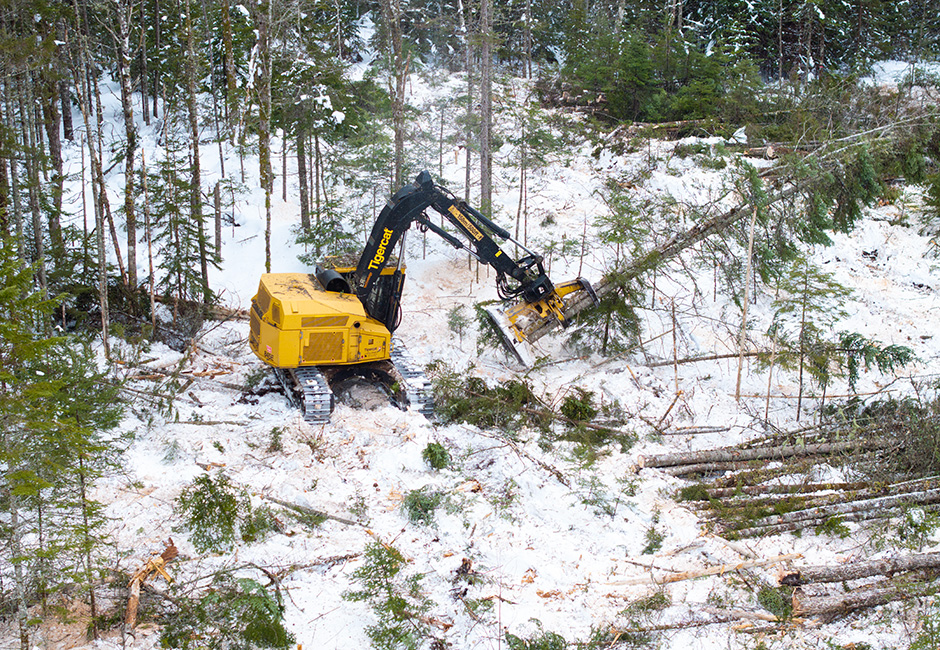
Shawn purchased the first 845E feller buncher. On certain contracts, he chooses to run the feller buncher and follow with in field processing.
Seven years ago, he purchased Tigercat’s first 845 E-series feller buncher from Wajax. Shawn ran the buncher four years steady until it was paid off. Now he can afford to deploy it more selectively. With only 12,000 hours on the meter, “That buncher will last us a long time,” he says, noting that in Nova Scotia, very few loggers are processing behind a buncher these days. “It is just too costly. If it is poor wood, the buncher can be an advantage, especially if the contract calls for a clean site.” The feller buncher is critical for clear fell contracts where everything — merchantable and non-merchantable — must be felled. Shawn also likes the buncher for training purposes. It is far easier to train a green operator on a feller buncher versus a harvester, and with a limited labour pool and aging workforce, training young operators with no experience is a reality.
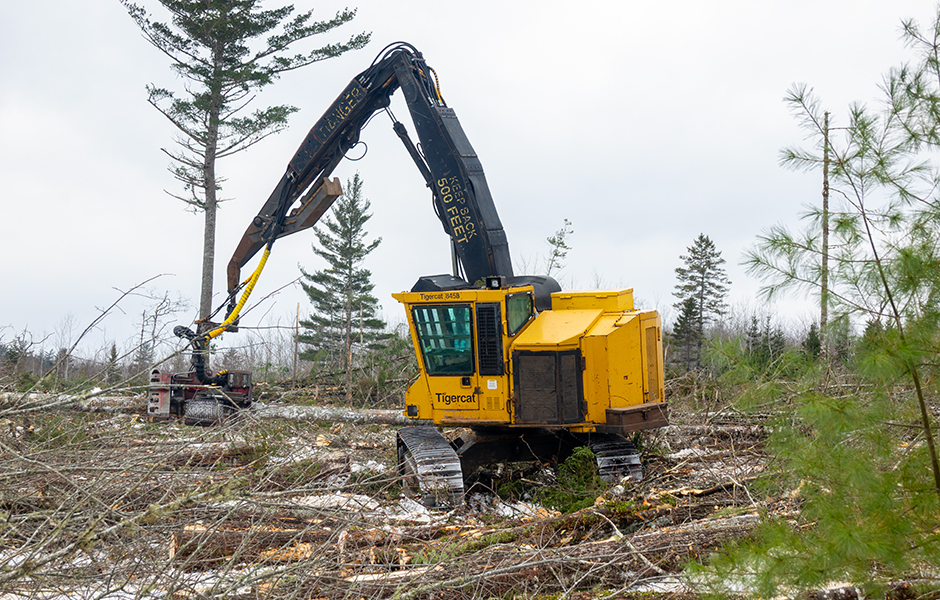
The company also runs two H845D harvesters, purchased new from Wajax in 2017 and 2018, and a 42,000-hour H845B. So, depending on the contract, Shawn can fall with the buncher and follow up with in field processing, or run a true CTL system, falling and processing off the stump. “In decent wood, the harvester cutting off the stump is more cost effective — a little slower but far lower operating costs.” The main products are stud wood, pulp, firewood, and biomass. The timber generally isn't large enough to yield many sawlogs.
Shawn’s 42,000 hour H845B harvester works every day.
Shawn moves a lot. He exclusively cuts private wood, and the blocks are getting smaller. “50 to 100 acres is considered a big contract these days,” he says. Having multiple machines and a flexible harvesting system allows Shawn to split up and deploy the machines to different jobs or to change the harvesting system to best match up to the requirements of the contract. For this reason, in addition to his two regular production forwarders, he also maintains a Tigercat 1075C as a spare that can be subcontracted or deployed as required to his own crews.
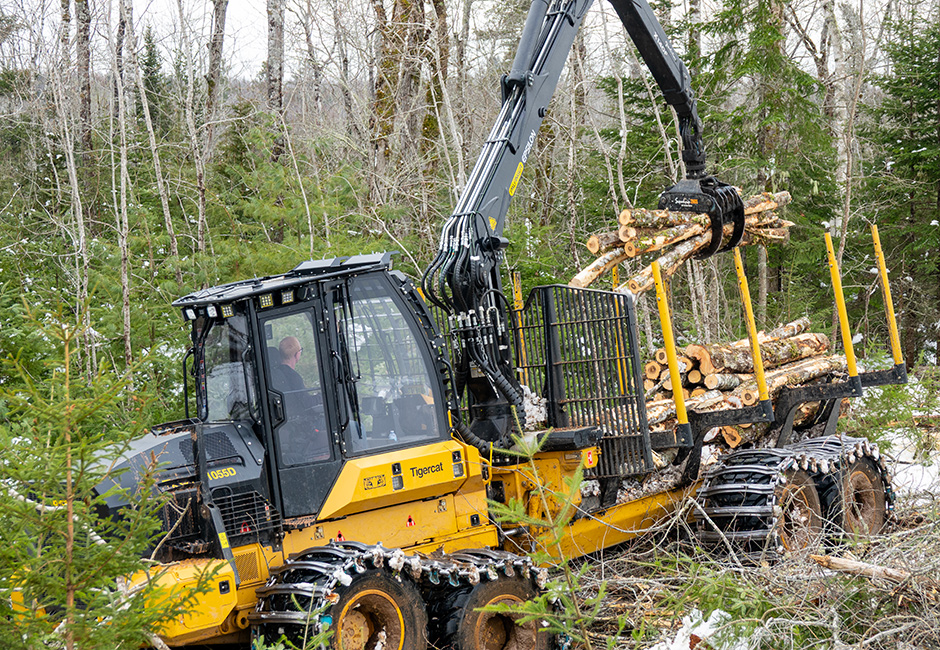
His newest machine is Tigercat's latest forwarder offering, the 1055D. Shawn’s is the first 1055D unit to operate in a regular production capacity since Tigercat launched the totally redesigned model last summer. He acknowledges that he took quite a chance on a brand new, unproven machine. Shawn says that it was Tigercat District Manager, Chris Baldwin who gave him the peace of mind and confidence to bet on the 1055D. “He's a phenomenal guy. You guys are lucky to have him. He has treated me and Nathan better than anybody I've ever had dealings with.”
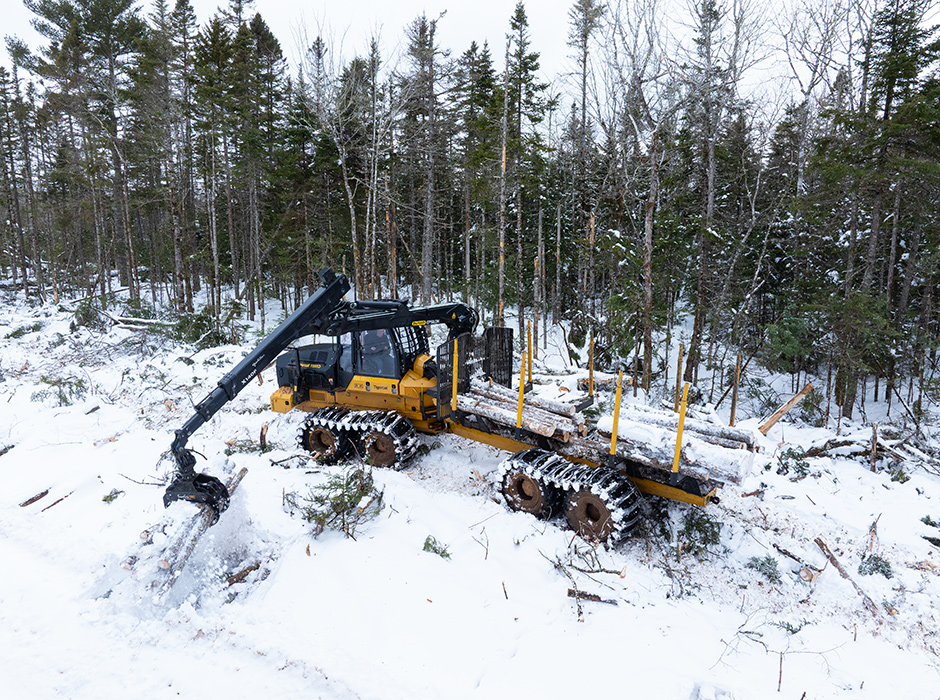
Nathan MacPhee operates the 1055D forwarder, the first unit put to work since the model was launched last year. Nathan asserts that it is the perfect size for his needs.
Shawn’s son Nathan has been working in the woods operating machinery since he graduated high school. He is the primary operator of the new 1055D, and also has seat time on the 1075C. When Shawn first purchased the secondhand 1075C, Chris rewired the controls to accommodate Nathan’s limited use of his right hand. It was a big job, and it stuck with Shawn. Upon request, the 1055D was delivered from the factory with the primary functions moved to the lefthand control pod and joystick.
“Nathan is a pretty good kid,” says Shawn. “He's the first one on the job in the morning, and the last one to leave. On account of his handicap, he works harder to make up for it, and he'll often work Saturday and Sunday.” Shawn says the smaller and lighter machine is much better suited to the company's needs than the big 1075C. “Where we were today, that is big wood for us. We are used to trees where we are getting two sticks of stud wood.” Shawn explains that they do some forwarding for Irving in their thinning operations. “And we do a lot of work for Tufts Forestry, who has been buying blowdown wood since the hurricane [Ernesto] in 2024. The 1055D is better suited for everything we do.”
Nathan likes the fixed bunk system and comments on the great visibility to the crane and work area.
A lot of service and component access enhancements that have been designed into the 1055D are highly valued by Nathan. He likes the new powered front hood and appreciates the easy access to the batteries that have been relocated to an exterior compartment on the right side of the hood. On the opposite side, there is a large tool storage area that also houses the main disconnect switch. There are additional compartments for spare hoses, tow chains, and tools on each side of the machine. In addition to the power operated cab access ladder in the front, there is a mid-frame manual fold down ladder to access the fuel tank. Dedicated lighting illuminates daily service areas including the fuel fill area. The lights are timed to turn off automatically if left on after fueling. Nathan comments that the quick coupler for the hydraulic fill is very helpful.
Nathan also comments favourably on the cabin. “I like the food warming oven in the cab; that is a nice feature. I like the large control system screen and the back-up screen. I like the lightweight cab door. It is very easy to work. The back window is massive. It’s curved so you can see everything. If you have to get the crane way up, with the lighting and the curved window, it makes it easier to see. The back-up light and camera are a massive help to me.” Nathan likes the tire pressure monitoring system and comments that the new cab is a nice space to be, with generous storage areas to keep things organized during long shifts. “It has nicer keypads. Everything just feels better.” Nathan also comments that the cab is much quieter.
The D-series cabin underwent a complete redesign. The result is improved sightlines, better ergonomics, more storage space, and a quieter working environment.
He also prefers the fixed bunks, noting that the telescopic bunks on the 1075C freeze in wintertime. “I really like the size of this machine because we do a lot of tight spots. Just as an example, when we are road building and we put in a bridge, we have to leave a buffer on each side and that makes it harder for a big machine to get through. The 1075 is just too big for us.”
The company produces around 750 tonnes per week, hauling all the product with one company-owned log truck and one full-time hired truck owned by Frank Daye Trucking. Shawn also owns a float truck. Although the company produces less volume than in the past, roadbuilding and floating machines for other contractors help to round out the revenue. The Nova Scotia industry has a six-week break-up period in early spring. “All the machines come into the shop, but we like to keep at least one harvester running through the breakup.” Shawn takes on as much of the repair work as possible. “We try to try to keep all the guys working, and it gives them something to do during the breakup.”
The employee count hovers at seven or eight. Shawn’s operators and drivers are a mix, with young workers at one extreme, and a couple of highly experienced veterans on the other end of the spectrum. It’s a challenging local industry, and the commonality among the crewmembers is that they all put in long hours and they like the work. “It's not a glorious job, so you’ve got to like it,” says Shawn. “You’ve got to like working in the woods.”