Six-way skidder blade adds functionality and solves problems for California harvesting contractor.
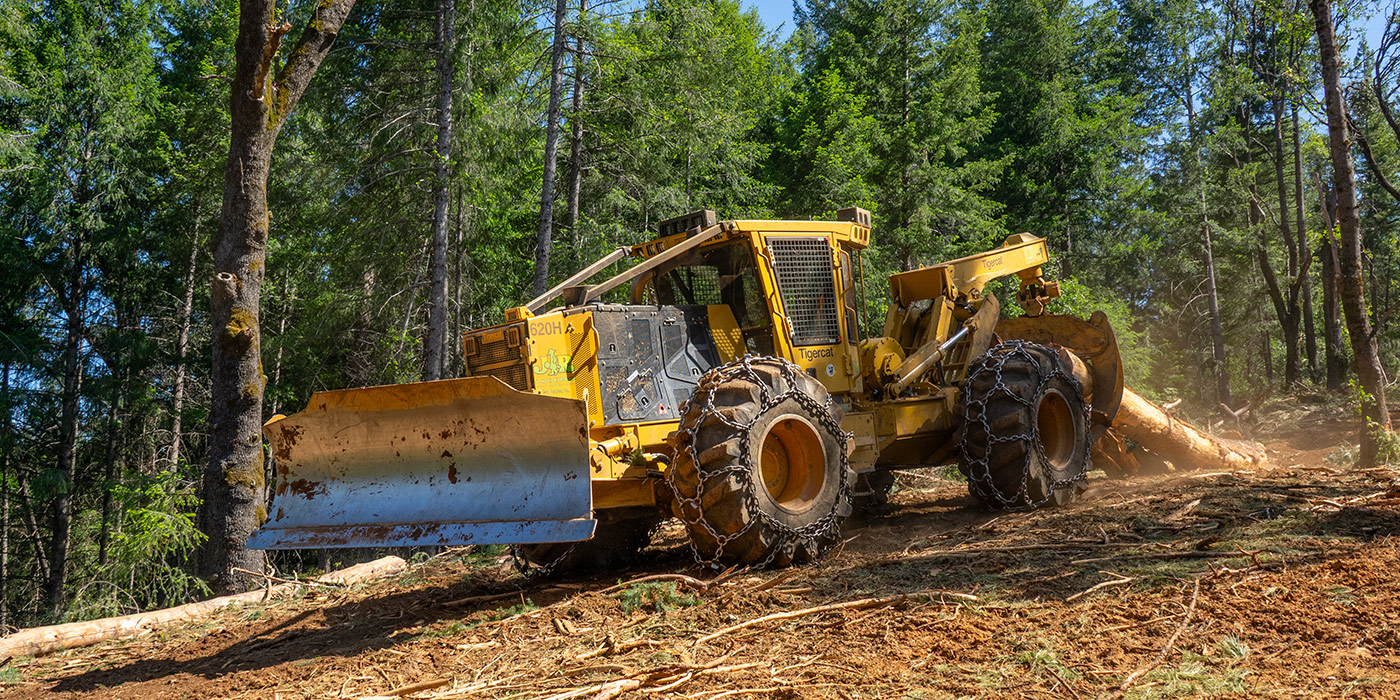
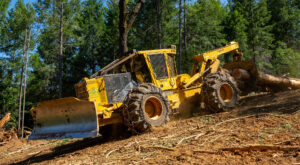
The company’s latest 620H skidder is equipped with the first six-way skidder blade.
Robert D’Agostini Jr. and Saul Jimenez are owners of J&R Logging based in Mt. Aukum, California. The company was profiled in Between the Branches in April 2023, highlighting innovative thinking and an openness to new ideas. J&R was a relatively early adopter of Tigercat’s hydrostatically driven yarder concept. Robert spelled out the many advantages of the 180 over the conventional yarders that the company previously relied on, including increased safety and productivity, and reduced specialized labour requirements.
Similarly, for many years, J&R integrated Caterpillar 527 skidders into its logging operations. These were dozer-based, grapple-equipped machines that offered versatility to handle the steep terrain skidding function as well as road building and road decommissioning duties. The model was discontinued around 2010, eventually leaving a gap in the machinery lineup for J&R’s logging crews.
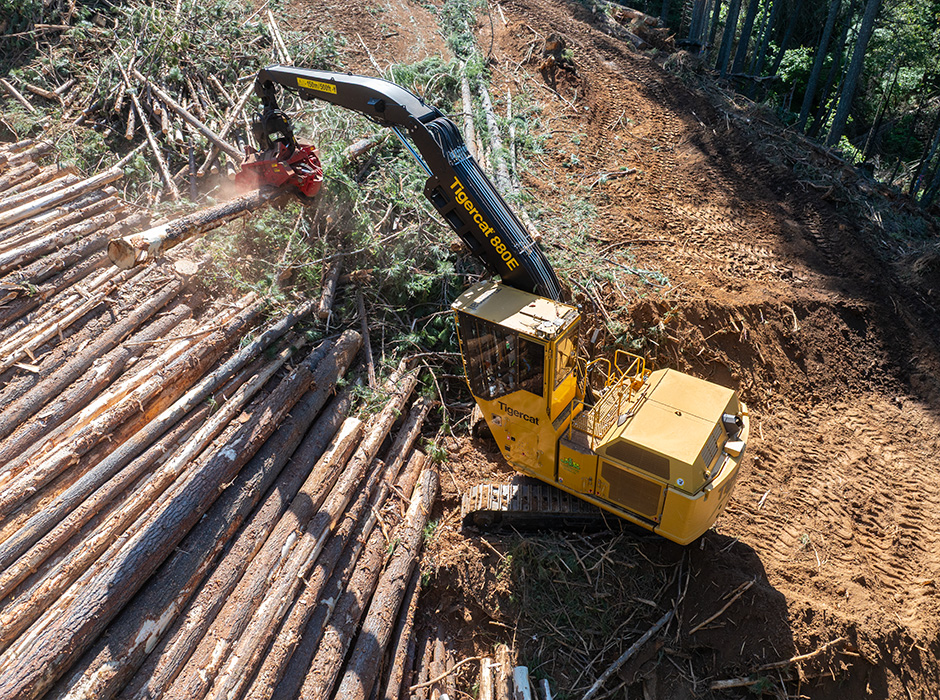
When Bejac Corporation acquired the Tigercat product line in 2020, it motivated Robert to have a close look at the brand. Since then, the Bejac team and J&R have developed a strong relationship, and the company has integrated multiple Tigercat models into its equipment fleet including skidders, track harvesters, the LX830E feller buncher, and shovel loggers. Most recently, the company purchased its first Tigercat logger, an 880E model equipped with a loader/processor attachment.
Two 620H skidders pulled to J&R’s latest machine, an 880E logger.
As Tigercat machines were added to the fleet, Robert and Saul were able to improve on steep terrain ground-based extraction by replacing the track skidders with Tigercat leveling shovel loggers, gaining improvements in productivity, mechanical reliability and operator comfort. However, the challenge of replacing the functionality of a dozer (without simply adding a costly and underutilized dozer into the crew machine mix) remained unsolved.
The Bejac team, in discussions with Tigercat’s engineers, believed that the dozer concept for a skidder could provide a solution, especially for forestry companies that were willing to explore the benefits a multifunctional machine could provide. Bejac knew that J&R Logging would evaluate interesting concepts and would be able to analyze and justify the additional costs of a product that offered increased versatility. Bejac’s relationship with J&R Logging led to the collaboration with Tigercat to develop a solution.
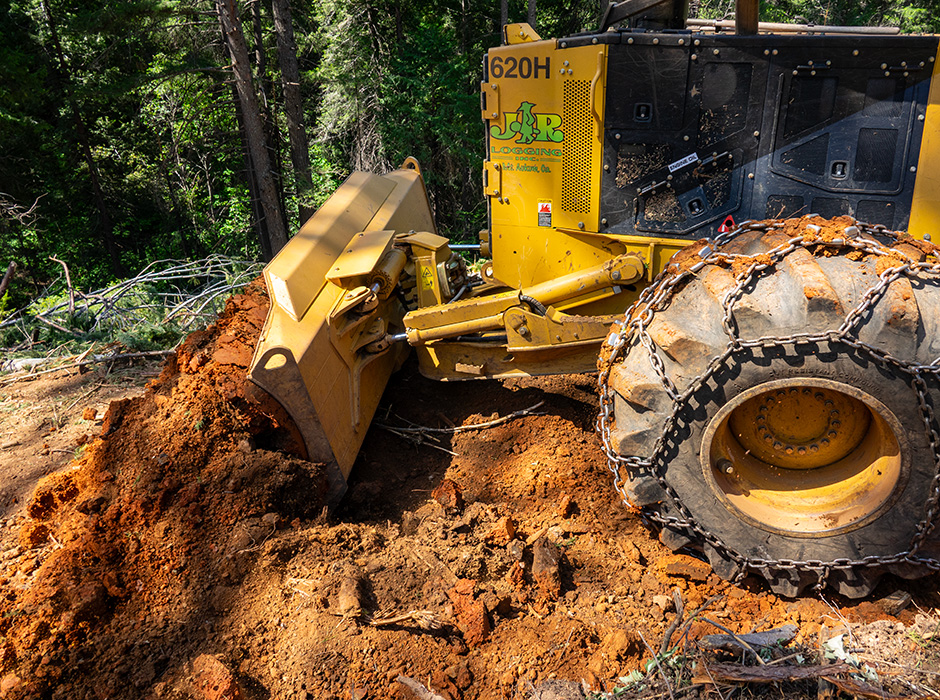
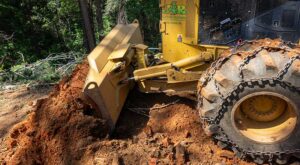
The 620H cuts a water bar to decommission a skidder track. The six-way blade is multifunctional and a great asset on logging operations, allowing the crew to build decks, roads and ditches.
“The Tigercat six-way skidder blade was a customer-driven development,” says Jeremy Piercy, Product Manager for the skidder group. “Over the years, talking with customers at shows, it would often come up as an idea that loggers thought would be useful. The idea was always on the back burner.” Following the development of the TCi 920 dozer, the idea became more viable, as much of the design could be carried over. “The 920 really opened the door to integrate a six-way blade onto a skidder,” Jeremy continues. “The idea came up again during customer tours and we started conceptualizing what it would look like. We had some rough layouts already complete when Bejac brought Robert on a factory tour. I showed him some screenshots of the layout, and I believe that gave him enough confidence in our design that he agreed to buy the first one if we built it.”
The six-way blade is now an available option on all H-series grapple skidders. J&R chose the 620H. “Water bars are legislated by the state on public and private land,” Robert explains. After finishing a compartment, the skid tracks must be decommissioned and water bars installed to minimize erosion and return the site to a more natural state. “We generally have two bunchers, two skidders and a processor on each job. Once a unit is finished, one skidder stays behind to cut the water bars.”
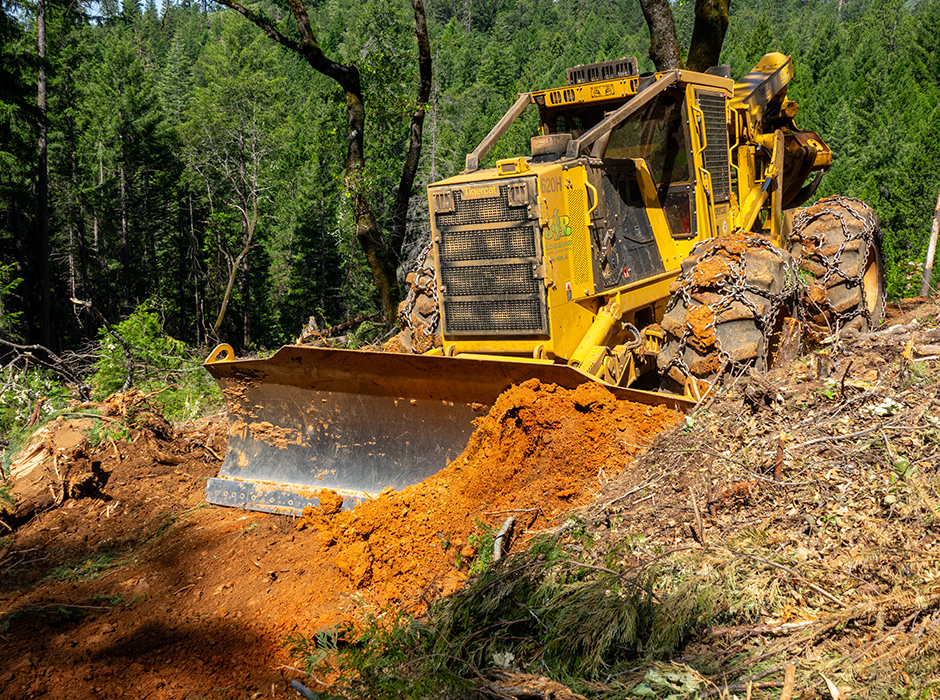
In addition to creating water bars, the machine can push open new decks, build roads and plow snow in the winter. It is a lower-maintenance-cost machine compared with a tracked dozer and far more versatile and multifunctional. Operations Manager Alex Jimenez adds that the extra weight on the front end improves stability and traction, making it a more capable skidder in the steep terrain that the J&R crews regularly encounter.
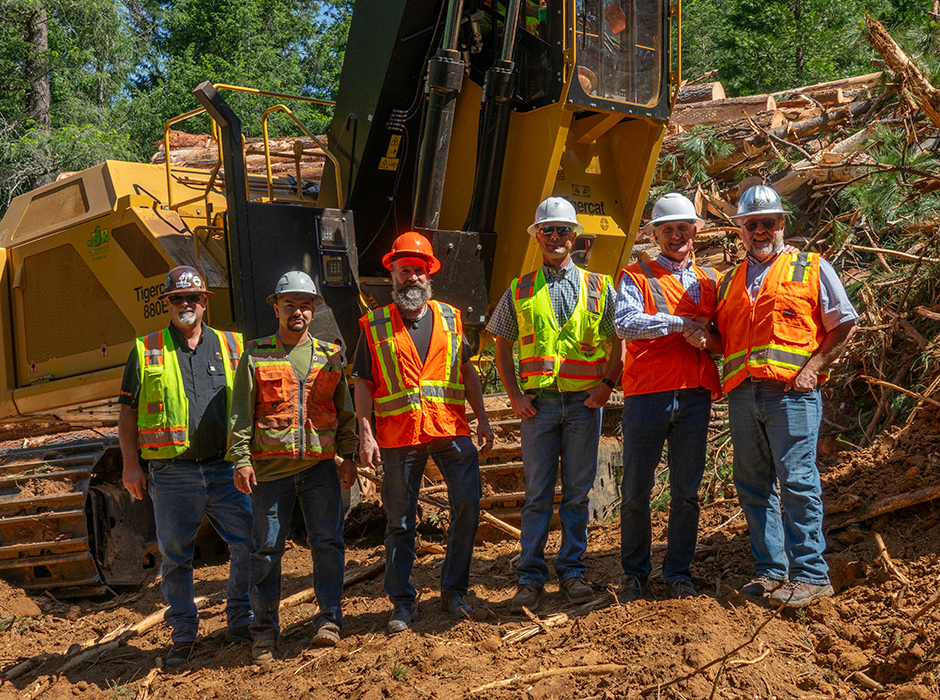
Brad Griffin, Product Support Sales Representative Bejac Sacramento; Alex Jimenez, J&R Operations Manager; Rob Selby, Tigercat District Manager; Kevin Barlet, Bejac Corporation Director of Operations; Ron Barlet, Bejac Corporation President and CEO; Robert D’Agostini Jr., President J&R Logging.
Robert concedes that in terms of pure grading performance, a wheeled carrier can never match a conventional dozer. However, the compromise is more than offset by the utility and convenience of having a capable six-way blade on a highly utilized machine that is already required on the job. For J&R, it eliminates the requirement and associated expense of bringing a dozer onsite.
Tigercat H-series skidders are available with an optional six-way blade for added versatility in the forest. In addition to standard skidder duties, expand the use of your machine with the ability to build and grade roads, clean out ditches, plow snow and move materials and debris off to the side and out of the way with less machine movement.
Watch the six-way dozer blade in action. The six-way blade increases skidder functionality, allowing a California harvesting contractor to build decks and roads, plow snow, and cut water bars to decommission skidder roads.