Operating cut-to-length machines along with a dual winch skidder, Aurélien Chauvy’s unique harvesting system and well-trained operators help him to excel in the steep private woodlots of Ardèche, France.
— Paul Iarocci
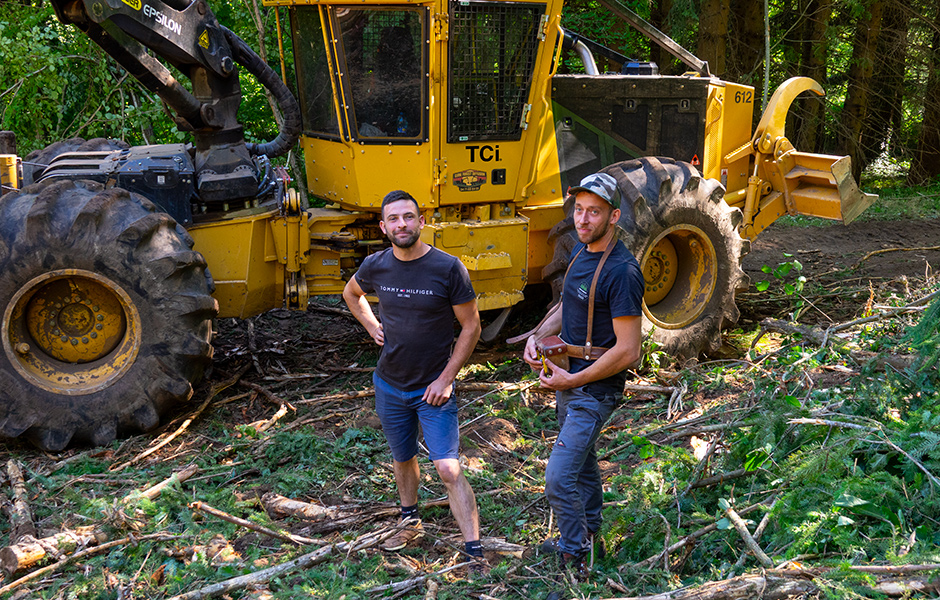
Company owner Aurélien Chauvy (left) with 612 operator Vincent Marion.
Aurélien Chauvy grew up on a farm in the picturesque Ardèche region of France. This is a place where narrow roads twist and turn through lush forests and pass by ancient villages seemingly untouched by the modern world. He developed a childhood fascination with machinery, and by age 21, Aurélien had left the family farm in pursuit of a life in the forest. He started off simply, with a chainsaw and a locally manufactured secondhand Camox cable skidder.
Seven years later, Chauvy Travaux Forestiers is a successful timber harvesting and hauling company. Purchasing timber from small private woodlot owners, Aurélien markets logs to five sawmills in the region. The company harvests around 40 000 cubic metres annually.
There was no magic to growing the company, Aurélien says, just long hours and hard work. As the business progressed, and he was able to further mechanize and purchase more productive equipment, Aurélien focused on finding the best and brightest operators. He emphasizes that operator quality is key to getting the most production, uptime, and lifespan out of the machines. The Chauvy Travaux Forestiers operators are young and formally trained. France’s forestry schools combine a strong academic program with a practical co-op component, where students learn the realities of operating machines.
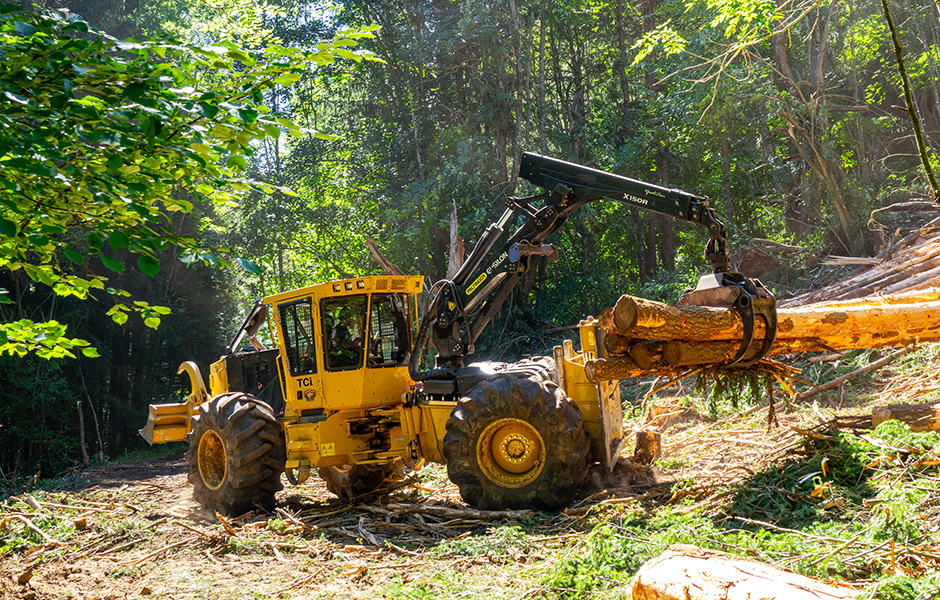
The telescopic crane adds flexibility, allowing the operator to extract trees, build bunches and sort products.
To get his product to the mills as quickly as possible, Aurélien also invested in his own trucking operations. He currently has three log trucks. Two additional trucks take care of machine transport from jobsite to jobsite. He purchases timber from private woodlot owners with volumes ranging from under 1 000 to about 3 000 cubic metres. The machines move frequently.
The company operates in a 40-50 km (25-30 mi) radius around the home base of Arcens. Typically, the crew produces and hauls two truckloads or about 100 cubic metres per day. The preferred product length is 16,3 metres (53 ft). The processor operator cuts out all defects and also produces three-metre sawlogs, the next-best product. Mixed diameter short wood pallet logs make up the remainder. Several species of hardwood and softwood are marketed to Aurélien’s sawmill customers in the region.
With steep terrain, a mix of selective and final felling, highly variable timber size, and a requirement to supply long and short log lengths, Aurélien needs a unique mix of equipment to run the operation efficiently. He also employs hand fallers for the largest trees and steepest terrain.
A critical part of the system is the TCi 612 dual winch skidder equipped with a telescopic crane. All steep hillside extraction is performed with the dual winches. The 612 also transports all the long-length wood from the forest to the roadside. For steep terrain clear felling, Aurélien employs a track harvester. The lower angle terrain is harvested with a TCi 1165 rubber tire harvester. All selective felling, which makes up about 40% of the total annual volume, is also performed by the 1165. As this is his first brand-new machine, he emphasizes that he now spends significantly less time on maintenance compared to his previous high-hour machine. The key strengths he highlights are the machine’s stability and visibility. Short wood is sorted and hauled to roadside with a forwarder.
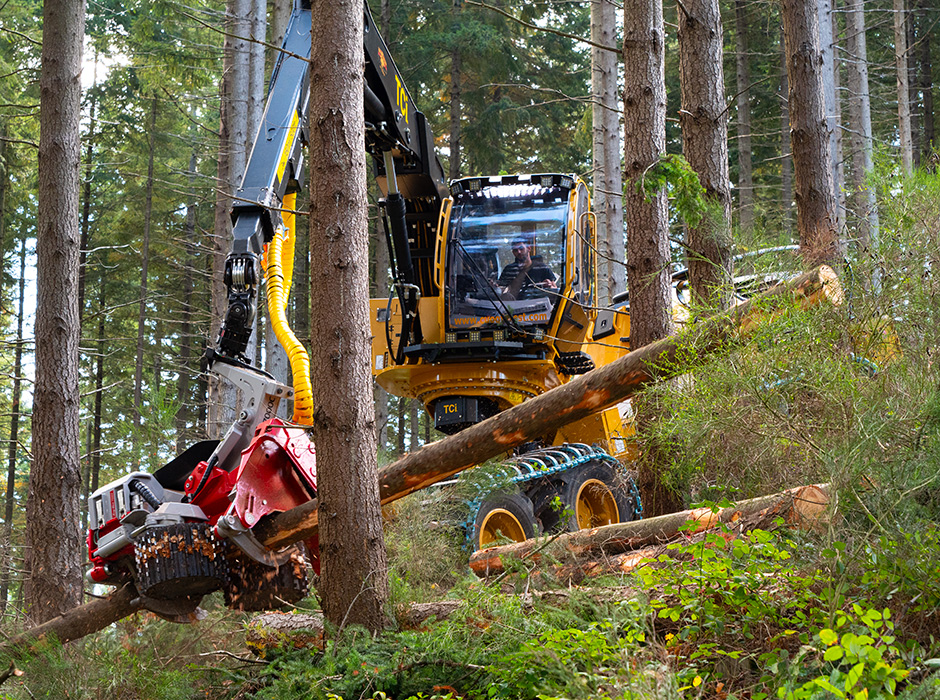
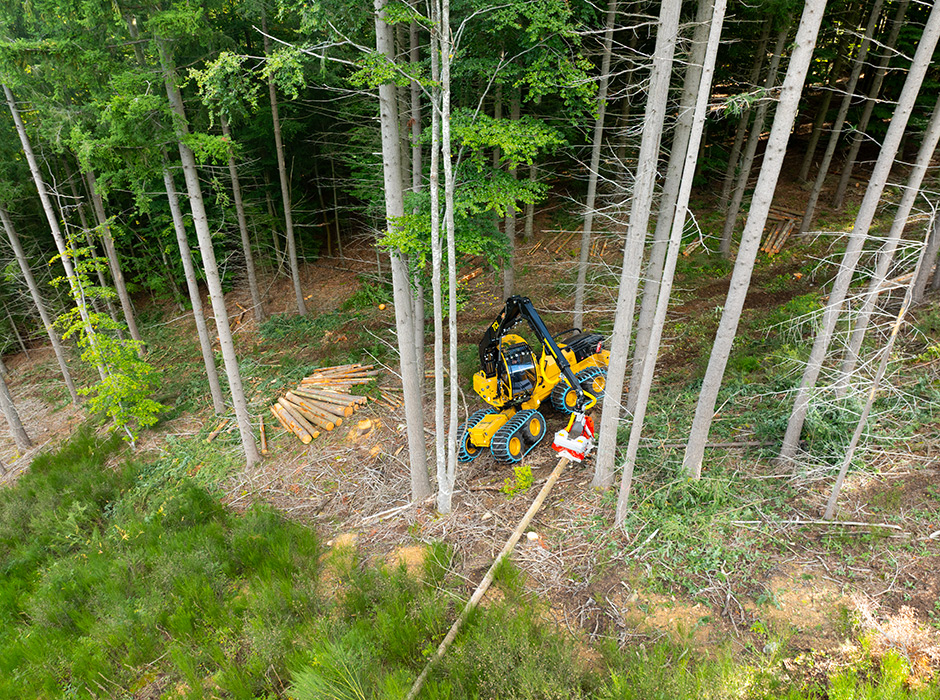
Aurélien notes that the 1165 is very stable and operator visibility is excellent, a great advantage in tight selective felling.
The harvest volume on the woodlot we visited is on the high side by French standards – 3 000 cubic metres. The site is accessed via an old gravel track, 200 metres (650 ft) from the paved road, at the base of a steep slope. In addition to the harvesting equipment, the company also owns an excavator for road building, and this contract includes a provision to build a skidder extraction road to access the top of the hill. When considering the road building required to access the timber at the upper reaches of the tract, Aurélien figures it will take two months to finish the job entirely.
This is where the versatility of the dual winch skidder comes into play. The machine can anchor at the top of the cutting area and extract timber up the hill with the cables. The double winch with two separate cables allows operator, Vincent Marion to work more quickly. He can latch on to scattered trees, maximizing payload for each cable extraction cycle. The telescopic crane adds versatility for extracting trees within close reach of the road. It is handy for positioning the trees behind the winch and shield assembly, and for unloading and stacking adjacent to public road areas where there is very little space. Sorting products in the forest is also a crucial function. The logs are transported to roadside in coordination with the arrival of a particular truck that is hauling a specific product to a mill. The crane helps to ensure that the logs are sorted, optimized, and delivered to the correct customer to achieve maximum value.
The TCi is built better than the other skidder offerings and the locally made skidders. People think that it is too big and heavy, but that is just a false perception. It really is not.
— Aurélien Chauvy, Owner Chauvy Travaux Forestiers
Vincent says it is a very good, strong machine. The crane is well positioned for clear visibility to the rear. The cabin is quiet and well equipped for long shifts. Operating a skidder in France is a very active job. The operator is often out of the machine, pulling cables down steep inclines, manually limbing trees and frequently operating the machine via remote control.
“The 612 is perfect because it's very strong and it's comfortable,” says Aurélien. “It's easy to work with from a maintenance perspective and from an operating perspective, so yes, the operator likes it.”
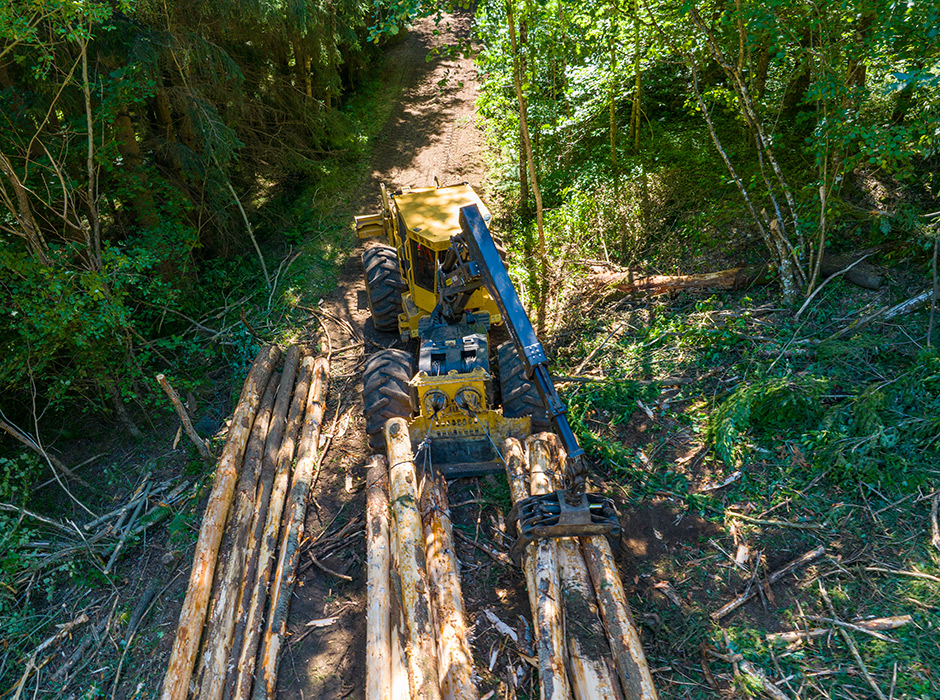
The TCi 612 skidder transports processed tree-length logs to 200 metres to the public roadside.
The 612 skidder was designed specifically for the operating conditions in France. French loggers appreciate that Tigercat Industries has entered the market with a strong alternative to European manufactured skidders. Vincent and Aurélien agree that they could never make production with a grapple skidder or a single winch. The configuration of the 612 is very important for their operations.
“The TCi is built better than the other skidder offerings and the locally made skidders,” Aurélien explains. “People think that it is too big and heavy, but that is just a false perception. It really is not.” He says the 612 achieves 25 percent greater production than smaller European skidders that have typically been used in France. “The visibility, position and control of the crane, and the extra power make it a better skidder,” he adds. “It is much more stable to lift much heavier loads to the side with the crane without a wheel coming off the ground. It is not confined to skidder tracks and often works in the forest in very difficult terrain.”
TCi 1165 harvester in a selective felling application.
It is not often that one can draw a clear line from the forest to the construction site. When it happens, it demonstrates the importance of trees and the timber industry, not just from an economic or engineering perspective but also from the lens of culture.
Since 2023, Cuoq Forest Diffusion has been distributing and supporting TCi equipment in France. This strong partnership is based on common values: reliability, technical expertise, and commitment. Matt Roberts, Vice President, Sales — Canada, Europe, and Asia, gives an overview of the TCi brand and explains how forestry professionals in France are benefiting from the TCi and CFD partnership.