Tony Iarocci officially retired from Tigercat Industries on June 4, 2026. Grant Somerville, former president of Tigercat, current director, and colleague of Tony’s for 48 years, writes about his life and career.
— Grant Somerville, Director
Tony Iarocci is a name that is synonymous with the Tigercat brand. He was the first president of Tigercat Industries, taking on the responsibility in late 1991 before the company had even chosen its name. This was the pioneering stage, where he led the creation of our engineering, sales, customer service, and parts organizations and the development of the early product lines.
Tony is best known for the thirty-five years he devoted to building and leading Tigercat, with twenty-six years as its first president followed by nine as its first director. However, some may be unaware that his lengthy career in forestry began many years before the creation of Tigercat.
Originally from Rome, Italy, Tony’s family immigrated to Canada in 1951, settling in Brantford, Ontario. His parents were strong believers in hard work and education. Following good advice, he pursued a university education, and in 1966, earned a degree in mechanical engineering from the University of Waterloo.
That same year he began his career at the Koehring Waterous Company located in Brantford. Founded by the Waterous Brothers in the late 1800s, the company initially built steam-powered machinery, then in the 1920s became a prominent manufacturer of enormous pulp grinders for paper mills. It added construction machinery in the 1950s and then forestry machines in the 1960s. In forestry circles, the Koehring Waterous name is best remembered for the development of the high-speed disc saw felling head, but it produced a wide variety of influential machines for both the forest harvesting and pulp and paper sectors.
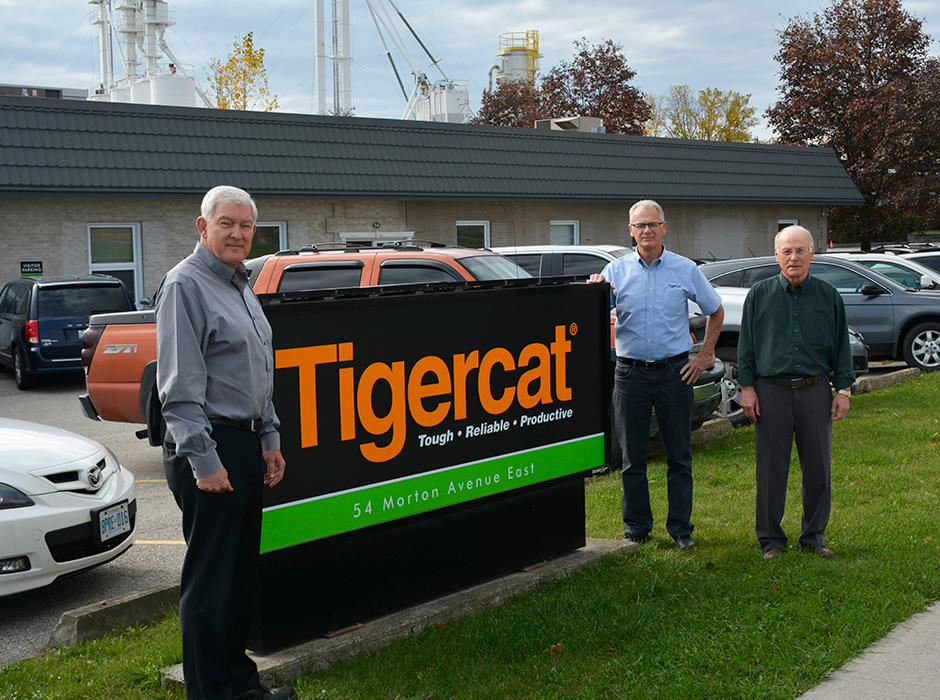
Three presidents: (L-R) Ken MacDonald, Grant Somerville and Tony Iarocci.
This era of Tony’s career exposed him to the design, development, manufacture, and field support of machinery for use in both paper mills and forests. It sparked a lifelong interest in the development of innovative machinery, a necessary building block for the future challenge of growing Tigercat.
During the 1970s, the company focused development efforts on large, wheeled harvesters and feller forwarders used to harvest softwood from northern forests in Ontario, Quebec and the Maritimes.
The harvest was primarily used to produce pulp and paper products, with machine fleets owned and operated by large paper companies. Most of the workforce lived in company-owned camps due to the remote locations. Machine fleets typically operated 24 hours per day, five days per week, with downtime for spring break-up and Christmas. Harvesting environments in these northern operations varied from muskeg to exposed rock, with long, hot summer days at 30 °C and long, cold winter nights at -30 °C. Machines would often log 40,000 hours of service before being decommissioned. This challenging application demanded aggressive product development and field support programs, and close collaboration between manufacturer and customer.
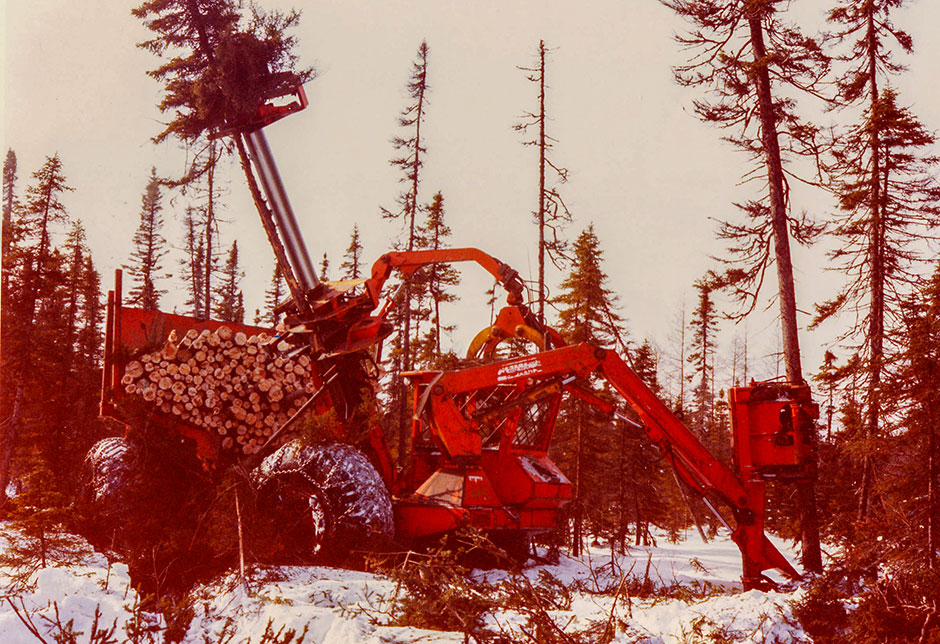
The Koehring shortwood harvester
Tony managed Koehring’s parts and customer service operations for several years, giving him insight into the day-to-day challenges faced by both customers and manufacturers in these conditions. During the deteriorating economic times of the early eighties, he was promoted to senior management roles in marketing and engineering.
By this point, large producers were shifting to a mix of pulp and dimensional lumber production. Sales of large harvesters designed to produce only pulp logs declined. The company shifted focus toward large feller forwarders that delivered clean full trees to roadside where they could be merchandized into logs destined for pulpwood or dimensional lumber.
By the mid-eighties, economic pressures led producers to shift away from owning and operating large machine fleets, replacing company operations with private contracting companies. The enormous wheeled feller forwarders became dinosaurs that private contractors could neither afford to buy nor support.
For the most part, the shift in North America was to feller bunchers and grapple skidders, marking the birth of the most common logging system in use today. This created a need for lower cost machines, and the company was searching for new opportunities.
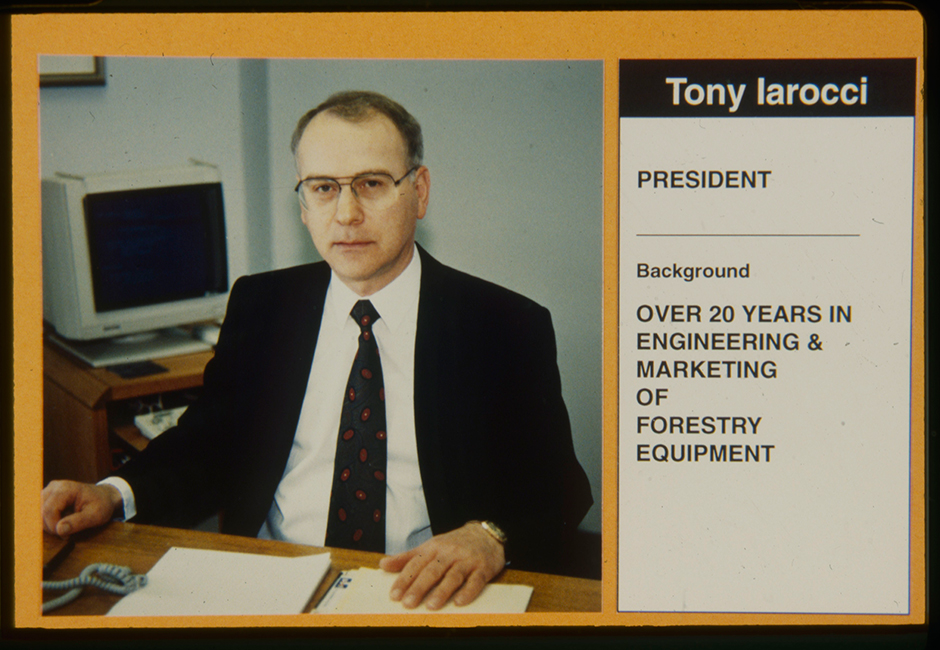
Part of a very early slide deck that served as a company introduction. Note that this was pre-PowerPoint. Presentations were shown on an actual slide projector.
Tony championed the idea of designing and building a more productive and reliable tracked feller buncher. While competitors were modifying excavators into feller bunchers, Tony’s vision was to produce machines that were designed from the ground up specifically for the forest industry — something that would build upon the company’s many years of experience, while offering the forest industry a more affordable tool.
A prototype was built in nine months. (It shipped on June 4, 1984, ironically 42 years to the day before Tony’s retirement.) The track feller buncher was a winning concept. The design and market timing were right, and the product line grew quickly throughout the decade.
However, the eighties remained challenging. The company fell victim to the Wall Street mergers and acquisitions craze, and in 1988 the holding company sold Koehring’s Brantford forestry-based division to Timberjack. The new owner continued to develop the track feller buncher product line. As such, the Koehring machine proved to be the root for the two largest producers of purpose-built track machines sold in the world today.
Leaving behind the years he invested in Koehring was difficult, but Tony got on with his career. He earned a management role with a local hydraulic component manufacturer and later became vice president of King Equipment. Then, in 1989, another challenge came in the form of a car accident that nearly claimed his life, leaving him with a long and painful recovery period.
In 1990, he took on a teaching role in the faculty of engineering at Conestoga College. As fate would have it, one day in 1991 he bumped into Ken MacDonald. They knew each other from Tony’s Koehring days when Ken’s MacDonald Steel company was a supplier of weldment components.
MacDonald Steel was struggling under the recession of that era. Most of Ken’s customers were also struggling, or worse yet closing, and he needed to act. He made an existential decision to build complete machines rather than components for other manufacturers. Ken knew Tony’s capabilities and offered him the challenge to create a forestry product line for his company.
This was the coming together of two very complementary individuals. While their backgrounds and skill sets were quite different, together their abilities proved a very effective combination. What they did share was an entrepreneurial nature, a strong work ethic, and a high degree of self-confidence.
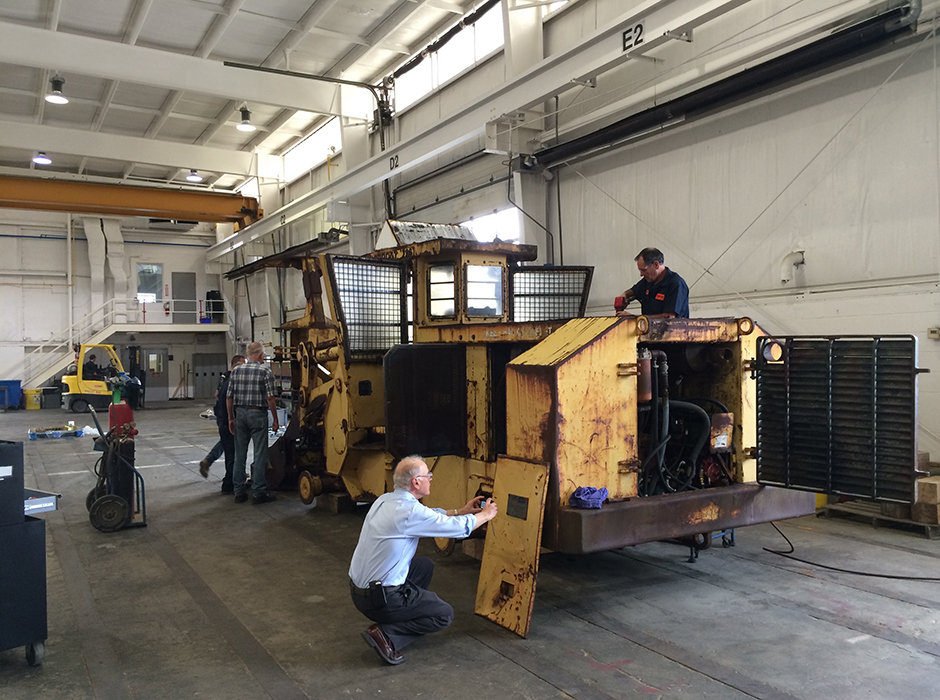
Tony inspecting the prototype 726 feller buncher that he helped to design and market. In 2017, the machine was returned to the factory and rebuilt.
Extensive field research conducted by Ken, Tony and the small team they had assembled determined that the starting point should be a wheeled feller buncher for the southern US market. They built the prototype 726 feller buncher in nine months, finishing it in the spring of 1992. The assemblers completed the machine while working in motel parking lots en route to the forestry show in Tifton, Georgia. It cut its first tree just before this live demonstration event started. A gutsy move, but this machine proved to be a winner and became the keystone upon which Tigercat was built.
Tony ensured that the research and design methods used for the 726 project became the model for all future Tigercat development programs: travel to the field, listen to customer ideas, likes and dislikes, research the competition’s strengths and weaknesses, develop solutions and innovations, and make machines that are tougher, more reliable and productive. Then follow up by responding to customer feedback with rapid product improvement. Respect your customers as your business partners. These were lessons learned through twenty-five years of experience.
The list of development projects led by Tony was long and diverse as he and his team released a new product every year. The pursuit of innovation led to advancements like dual post bunching saws and shears, the hydrostatically driven skidder, and ER technology for boom systems to name just a few. These and many other developments led to major advancements in the productivity and efficiency of logging operations worldwide. The sheer scope of product development undertaken by Tigercat during this time period is difficult to convey.
Of equal importance and challenge was the development of a high-quality dealer network, and capable customer service and parts networks to support them. Tony recognized the critical value of these aspects of the business and devoted much of his time to them.
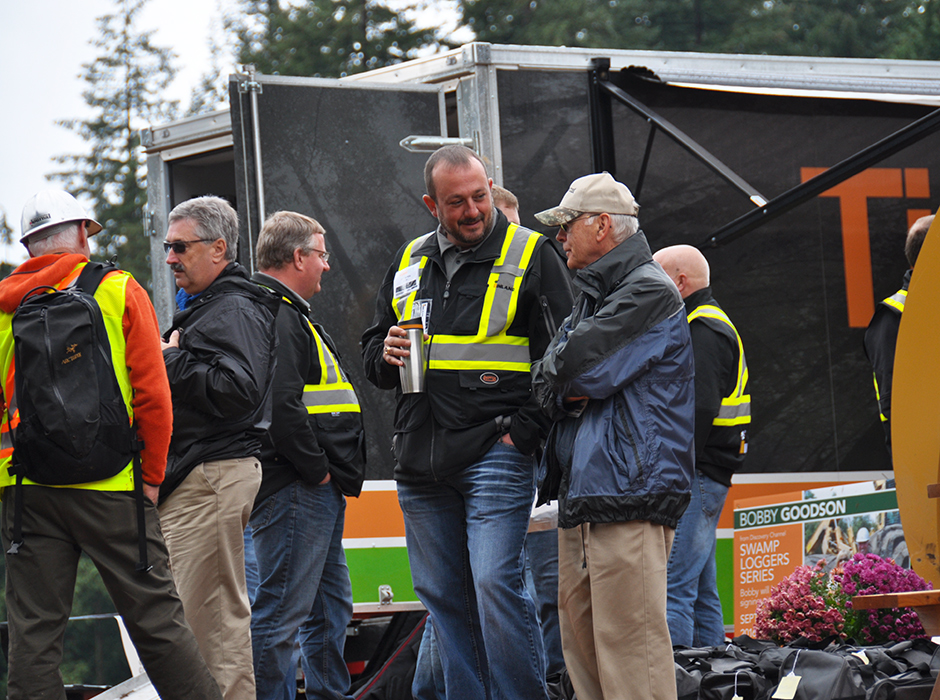
During his career, Tony highly valued travel and interactions with dealers and loggers.
A part of the process often unseen to customers is the partnerships that must be forged with numerous component and service suppliers. Forestry is a demanding application that most commercially available components are simply not designed for. Tony relentlessly led joint development projects with component suppliers to create forestry-capable parts — everything from hydraulic pumps to paint. When this proved insufficient, he led the development of Tigercat manufactured alternatives like our axles, transmissions and final drive gearboxes.
Tony believed in seeing things in person to experience challenges firsthand. He travelled to many countries to visit vendors, factories, dealers, customers and forest operations. He regularly drove through the southern US to meet with dealers and customers, spending long hours on the road and literally wearing out vehicle after vehicle.
Tony and Ken created a unique culture at Tigercat. They worked hard and asked the same from their team members, but they also knew how to enjoy the off-work hours. They never let their job titles become status symbols and they were genuinely respectful of everyone. They kept morals as their compass, something that has become too rare these days.
Tony is a rare mix of old school and new school. On one hand, he is a disciplined professional engineer with many of the traditional values of his era. But he is also a progressive thinker who places high value on common sense. His balance of science and practical thinking proved well suited to the design of forestry machines. He listened to what customers wanted rather than telling them what they needed, establishing a key component of company culture that became a driver of Tigercat’s success.
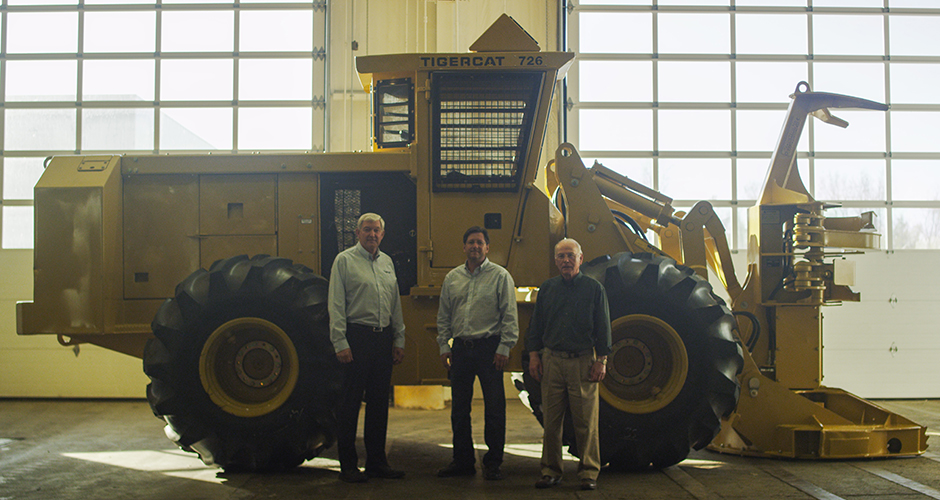
Ken MacDonald, Jon Cooper and Tony stand in front of the rebuilt 726 prototype in 2017. Jon and Tony worked together to design the machine in late 1991 and early 1992.
Tony chaired countless meetings with component manufacturers, dealers, customers and Tigercat staff to solve problems. Everyone came to respect his engineering competence, his passion for solving problems regardless of detail or scale, and the success that followed.
Tony was a team builder. He was exceptionally good at reading people and identifying those with potential. He challenged young people to do big things. As a leader, he always kept himself well informed so he could make good decisions. He was exceptional at asking the right questions to get to the root of an issue. He was decisive, believing indecision was worse than the wrong decision. Throughout good times and bad, he remained optimistic and on course.
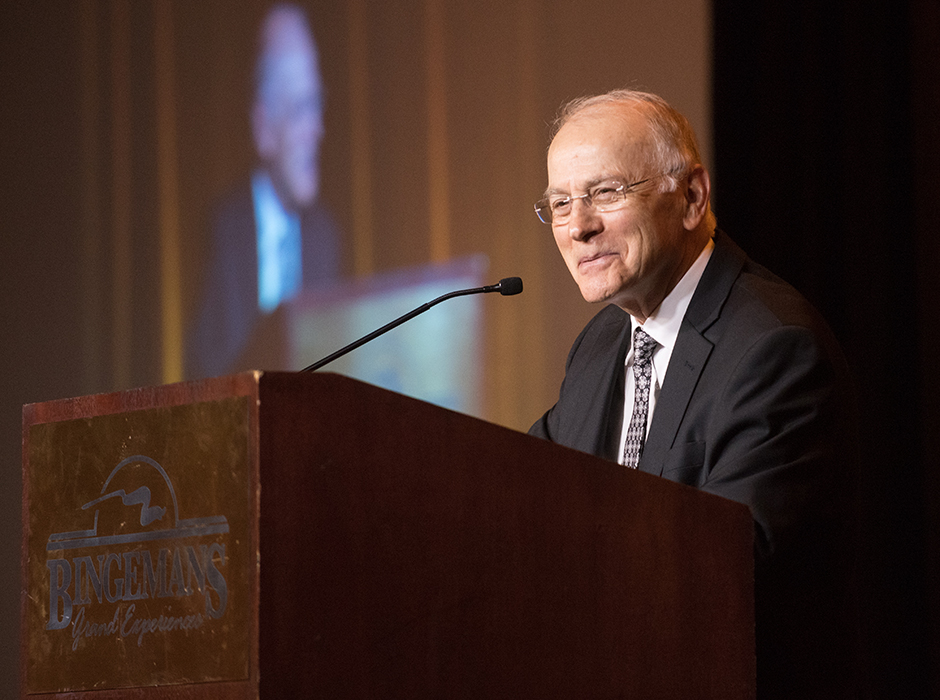
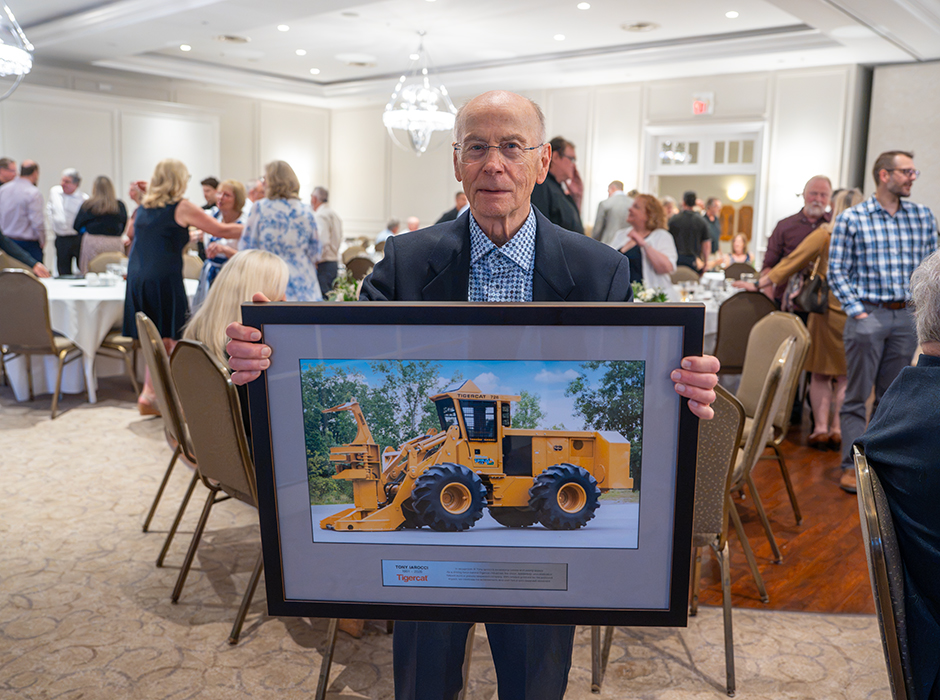
Tony’s retirement celebration in June 2026 after 35 years with Tigercat Industries.
He was always present: at shows, meetings, factory tours, social events, on the factory floors, and in the woods. He was the face of Tigercat. Tony’s belief in himself and his team led to accomplishments that the industry said couldn’t be done. He led the creation of a new brand of forestry equipment in an already overcrowded marketplace while established brands were disappearing. It became the broadest product line in the forestry industry. Today, eleven manufacturing locations and a worldwide workforce of 2,000 team members build and support all kinds of truly innovative, high-quality products.
This is a glimpse of a 60-year career that made a significant contribution to the forest industry around the world and affected the lives of thousands. We all thank Tony for the countless hours, miles and sleepless nights he dedicated to making Tigercat Industries an industry leader. I would also like to acknowledge his wife Marsha for the support that she provided along the way, and for all the work she put into Tigercat that often went unnoticed.