Southeast Georgia fire department takes a big step to tackle the bigger problem of wildfire risk.
— Paul Iarocci
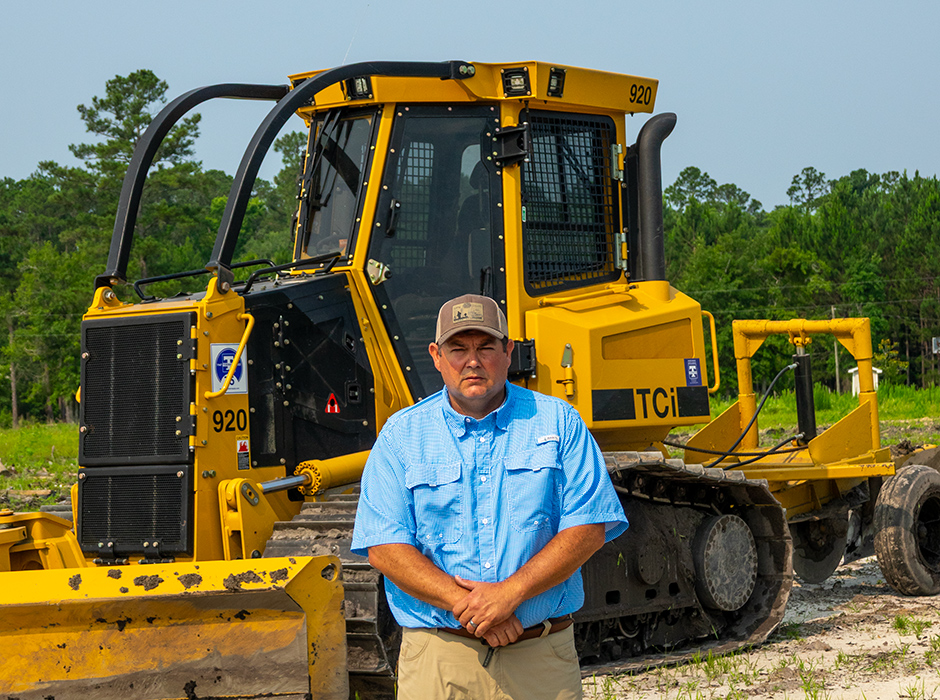
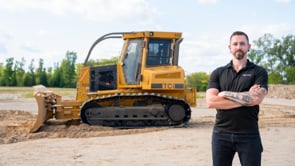
Chris Moss, Fire Chief standing in front of the Long County Fire Department owned TCi 920 dozer.
Long County falls within a densely forested region of eastern Georgia. With its proximity to the Fort Stewart military base and the coastal city of Savannah, the county is experiencing rapid population growth. New housing developments are springing up adjacent to working forests.
For the past eleven years, the county fire department, based in the town of Ludowici, has been headed by an experienced and forward-thinking fire chief, Chris Moss. The department employs fifteen full-time firefighters, 40 on a part-time basis, and twenty volunteer firefighters. A rural county fire department responds to the same types of emergencies as most other departments including medical calls, vehicle fires and accidents, and structure fires. With the county’s extensive forest coverage, Chris has even more weighing on his mind — the seasonal threat of brush fires and full-blown forest fires. In the drier months, the department might respond to a dozen small brush fires in a month. Given the right set of conditions, any one of those could progress into an out-of-control wildfire.
In Georgia, forest firefighting is a shared responsibility between two levels of government — local departments and Georgia Forestry Commission. As Chris explains, “We respond to brush and forest fires, and generally, if we can't handle it and we need assistance, we call Georgia Forestry. We've got a very good working relationship with them.” In addition, if a fire were to overwhelm the available resources of these two bodies, the Federal Emergency Management Agency (FEMA) may also step in. Other stakeholders with responsibility to prevent fires are timber management companies and federal land managers who oversee nationally owned forestlands. It’s a patchwork of ownership and responsibility to deal with a phenomenon that doesn’t care about boundaries or bureaucracy — just heat, fuel and oxygen.
Back in 2011, the county experienced a severe wildfire. High temperatures, low humidity, an absence of rainfall, and high winds combined to create the perfect conditions for a difficult-to-control fire. “My goal since I became chief of this department has been to do everything I can to be proactive so as not to have that situation occur ever again,” Chris explains. Through the Firefighter Property Program, Chris acquired surplus equipment from the military and repurposed it for firefighting. “We've been able to get two LMTVs [Light Medium Tactical Vehicles]. The military uses them as troop trucks, and we’ve modified them into brush trucks with water capacity. We can actually fight fires with them. They're also used for high water rescue.”
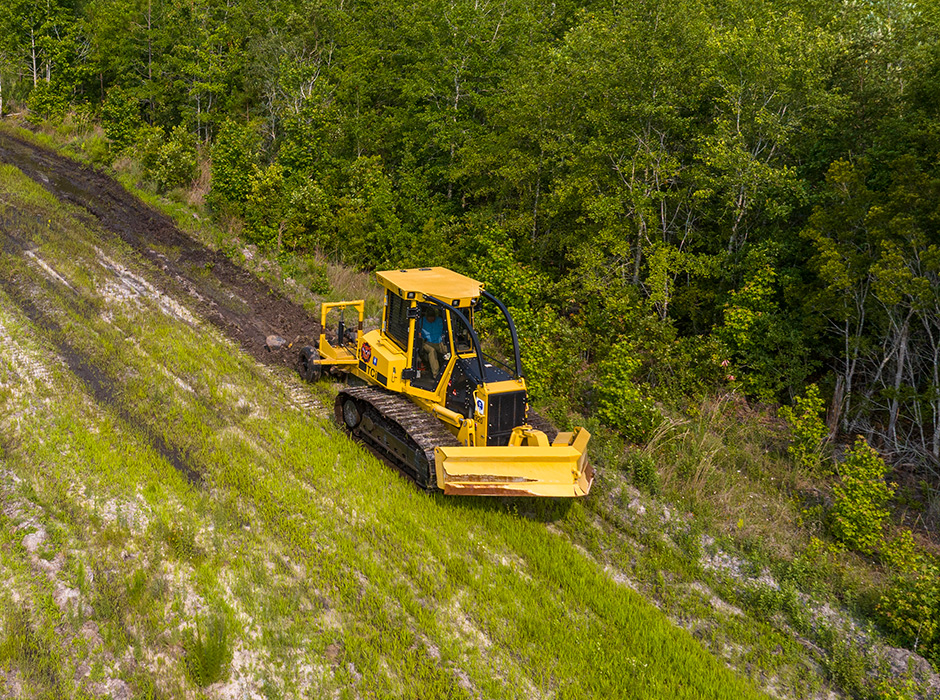
Chris makes a first pass on a perimeter firebreak with the plow engaged.
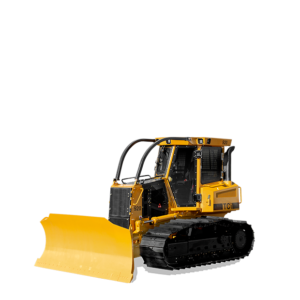
Once the department had the ability to access off-road terrain and fight forest fires, Chris decided that he also wanted the in-house capability to create and maintain firebreaks. Somewhat unique to a county fire department, Chris decided that the department would purchase its own fire dozer. “I like to have a backup plan for everything we do. Georgia Forestry is a vital asset to us and the entire state of Georgia. Purchasing our own dozer was just a contingency plan. If we need it, then we've got it.” Chris explains that the Georgia Forestry Commission and the local fire departments complement and assist one another. The county-owned dozer provides an extra layer of protection. “We're here to assist if needed. God forbid, if we have multiple wildfires in the surrounding counties and everyone is tied up on different fires, then we've got a backup plan. Our TCi bulldozer is ready to go. So that is the whole reason we purchased it — to have a backup plan if Georgia Forestry was not available to assist if needed.”
Natural disasters seem to have a way of building off one another. “We had two back-to-back hurricanes last year,” says Chris. “There's an awful lot of fuel that is down in the timberlands.” Not only does this further increase the risk of bigger fires, but it makes it more difficult and more dangerous to plow breaks through timber stands littered with deadwood and tangled blowdown.
God forbid, if we have multiple wildfires around the surrounding counties and everyone is tied up on different fires, then we've got a backup plan. Our TCi bulldozer is ready to go.
— Chris Moss, Fire Chief, Long County Fire Department
Long County’s TCi 920 is involved in two different types of firebreaks. The first is preventative. Aside from maintaining breaks on county land, Chris has initiated a new program offering firebreak services to citizens to protect private landholdings, which in turn helps fortify the entire county against fire risk. Chris says that preventative firebreaks usually follow boundaries, creating a firebreak perimeter around a property. For large forest blocks, firebreaks are plowed into the stand as well. “On a 100-acre tract of land, you might have multiple firebreaks. There could be one around the perimeter and then some inside. The breaks help to isolate and contain a small fire before it grows in intensity, as well as providing access for firefighting equipment. “It also gives landowners access to the forest as they may use that firebreak as a road. It's a very big hunting community here. A lot of people drive along firebreaks with their ATVs or UTVs, so there are multiple uses.”
When working an active wildfire, the firebreak is meant to be plowed at a safe distance ahead of or around the fire to contain and eventually stop it. “If you're plowing a break on a wildfire, the closer you get to the fire, the sooner that fire's going to die. You're opening up the earth and getting rid of the fuel,” says Chris.
Whether creating a preventative firebreak or working on an active fire, the process is similar. The machine makes a first pass with the plow engaged to break through the organic surface material, or duff, and open up a track. The idea is not to plow into the soil itself, but just to remove the top layer of dry or decaying debris. Minimizing soil disruption maintains the surface integrity, allowing vehicles to subsequently travel over the break. “You want to remove all the debris but try to keep the firebreak as shallow as possible. Especially around here, it's lowland. If you go very deep, then you're going to hit the water table. Of course, when we get water in our firebreaks, the trucks are going to bog down. So we try to keep it as shallow as possible and try not to disturb the land more than we have to.”
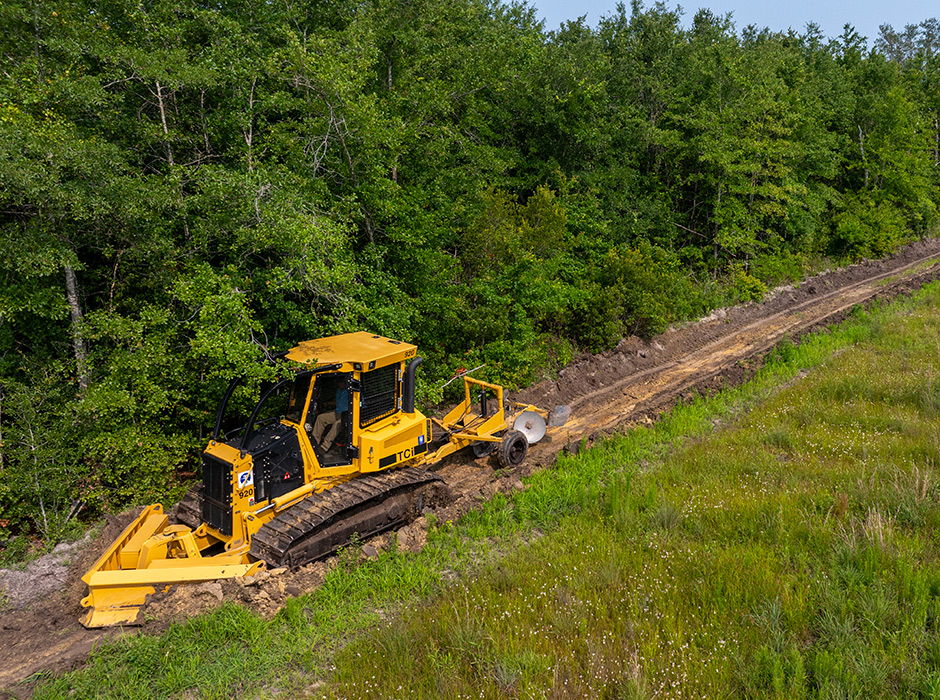
On the second pass, the V-blade clears any remaining debris, widens the break, and grades the surface to allow for vehicle access.
During the first pass, the blade is positioned above ground to push larger material like brush, branches, and downed timber out of the way. Then the dozer makes a second pass with the blade engaged, opening up the break to a greater width while grading the surface. “It not only gives you a wider break to stop the fire, but it also gives access for us to be able to get other vehicles in there. We call it mopping up. Once the fire is contained, then we go back to mop up and put everything out.”
A TCi solution
Living in rural Georgia, Chris had heard of Tigercat forestry equipment but he was surprised to learn the company also built a dozer under the new TCi brand. “I called up a friend of mine who is a local logger. I did not have a clue what equipment he runs. I asked if he knew anything about Tigercat and he started giggling, saying, ‘What do you want to know? That's all I'll run.’ I asked him if it was dependable.” The logger proceeded to relate that he still owned the first piece he ever bought and that it had worked 30,000 hours. “He didn't have to tell me anything else. That was unheard of. I've run equipment all my life and I've never seen 30,000 hours on anything.”
It not only pulled that four-disc plow, but it pushed an eleven-foot blade full of dirt at the same time. It made a believer out of all of us that day.
— Chris Moss
Chris contacted Van McLoon at Tidewater Equipment’s nearby Brunswick branch, inquiring about a TCi 920 dozer. “I aggravated Van for about a year,” Chris jokes. In fact, Van expertly guided Chris through the entire procurement process that eventually reached the all-important trial stage. “We lined up a demonstration and had a lot of folks from Georgia Forestry there and a few private contractors as well,” says Chris. The designated operator, fittingly known as The Bull, said that if it wouldn’t pull a four-disc plow, then they should just load it back up on the trailer. “So that's the first thing we did. It not only pulled that four-disc plow, but it pushed an eleven-foot blade full of dirt at the same time. It made a believer out of all of us that day.”
Tigercat dozer engineer Jason Schneider also attended the demo. “The Bull definitely didn't think our machine was up for the task compared to the dozer he normally ran,” Jason recalls. “He did several long, hard passes on the firebreak that would typically cause their other dozer to overheat, but no matter how hard he tried, he could not get the temperatures to budge. By the end of the demo, he was selling the machine for us.”
During the demo, Chris asked Jason about the possibility of specifying a V-blade for the machine. The engineering group started working on it, and Jason made a couple of subsequent trips to Georgia, augmenting the design and review process with online meetings. “He showed us the designs, tweaked it here and there. He allowed us to be part of the design team if you will. And lo and behold, it's sitting here on the dozer now and we are very pleased with it. I feel like we made a good decision.” Chris stresses that the support from Tidewater Equipment and Tigercat Industries has been top-notch.
Chris opted for maximum flexibility, purchasing both the V-blade and the standard six-way blade to make the machine more versatile. “The V-blade makes it easier to manoeuvre around stumps, large trees, and other obstacles in the forest. It’s easier to push through something with a V-shape as opposed to a wall,” Chris explains. “However, if there is a declared fire and FEMA comes in, they may request a six-way blade, so we wanted to have that option. If we can send the machine to a larger fire somewhere, it helps to generate funds for the county.” This was one of the ways that Chris helped to sell the idea of a dedicated fire dozer to the county commissioners.
Like insurance, everyone buys it and hopes they never need it. For Chris, it is the same with the 920 dozer, except that in this case, the machine is being utilized in the meantime to make Long County’s forests more resilient to fire, with the added benefit of potentially helping other jurisdictions fight fires. There is real potential to contribute to saving timberlands, homes, and lives. I get the impression that the thought of this may help Fire Chief, Chris Moss sleep a little better at night.
South Carolina contractor pulls the trigger on a TCi 920 dozer. His purchase decision is based in large part, on the strength and reputations of Tidewater Equipment and Tigercat Industries.
Gerrit Grotenhuis, product manager for TCi dozers, takes us on a walk-around of the TCi 920 dozer. The 920 excels in demanding applications like stump removal and road building on logging operations. It is smooth and responsive for final grading on construction sites. Watch this video to learn about the key features and benefits of owning a TCi 920 dozer.