Six-wheel skidders improve productivity and reduce environmental impact in the Appalachian range.
— Chris McMillan
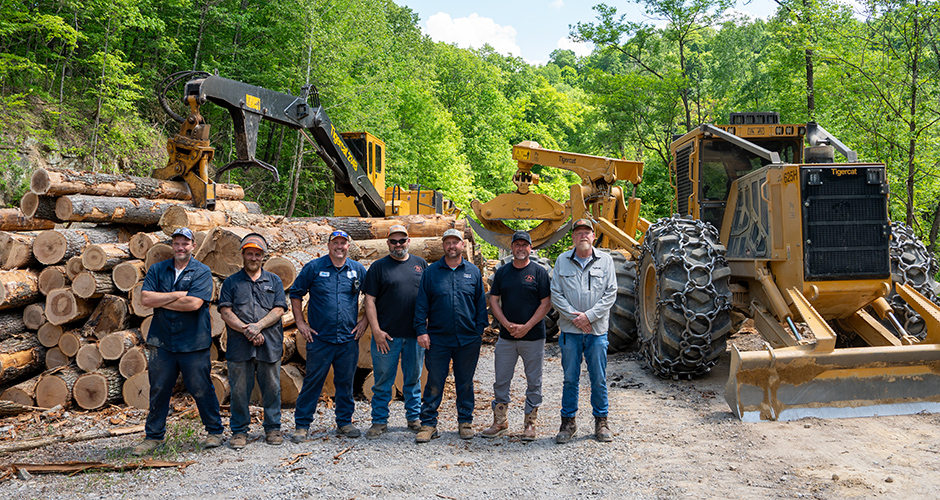
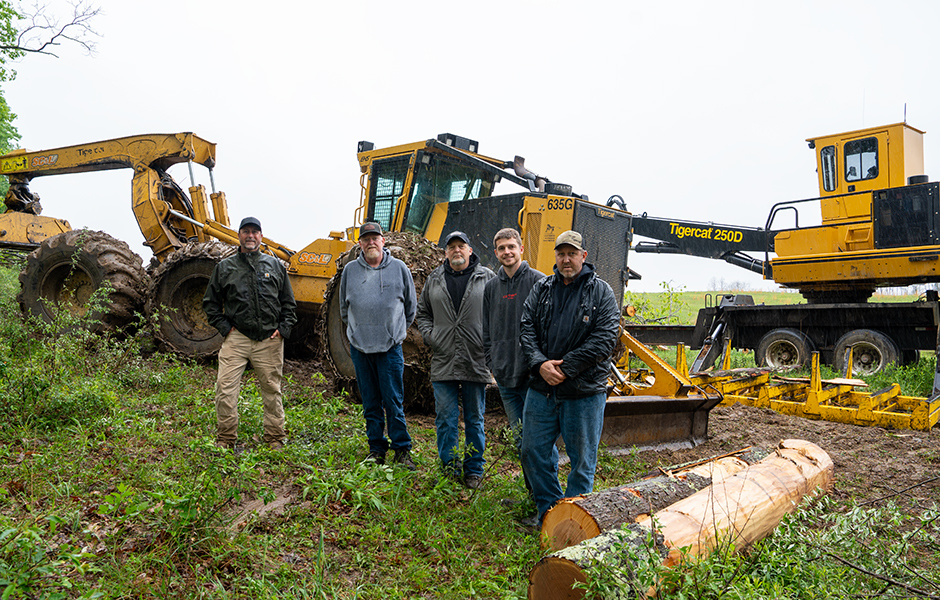
(L-R) Richard Dillon; Tony Wright (former Triple B employee); Phillip Woodall; Joey Adkins, Ricer Service Manager; Brad Woodall; Troy Sneddon, Ricer Regional Sales Manager; Jerry Smeak, Tigercat District Manager.
Tigercat has been building and improving six-wheel skidders for over 25 years. The machines are synonymous with steep slopes and extreme terrain conditions, and a component of many logging operations in West Virginia and Maryland. Between the Branches checked in with three contractors — all customers of Ricer Equipment in Summersville, West Virginia.
The rugged Appalachian range is the defining geographic feature of the area. Sharp mountain ridges descend into steep river valleys, along with the rolling hardwood covered hills that dominate the landscape. The region experiences high precipitation, adding further challenges for harvesting contractors.
Triple B Logging
Brad Woodall is a third-generation logger and owner of Triple B Logging based in Summersville. Brad has been logging for twelve years, working throughout several counties in the central part of West Virginia.
Brad’s brother Phillip (Woody) Woodall runs an excavator with a grapple saw, cutting and preparing the big hardwoods for Richard Dillon, skidder operator. Brad runs the loader and delimber at the landing, merchandising logs, and loading trucks. Rounding out the seven-man crew are Danny Snyder, who builds the roads ahead of the logging crew, and brothers Russell and Mark Hamrick, who drive the haul trucks.
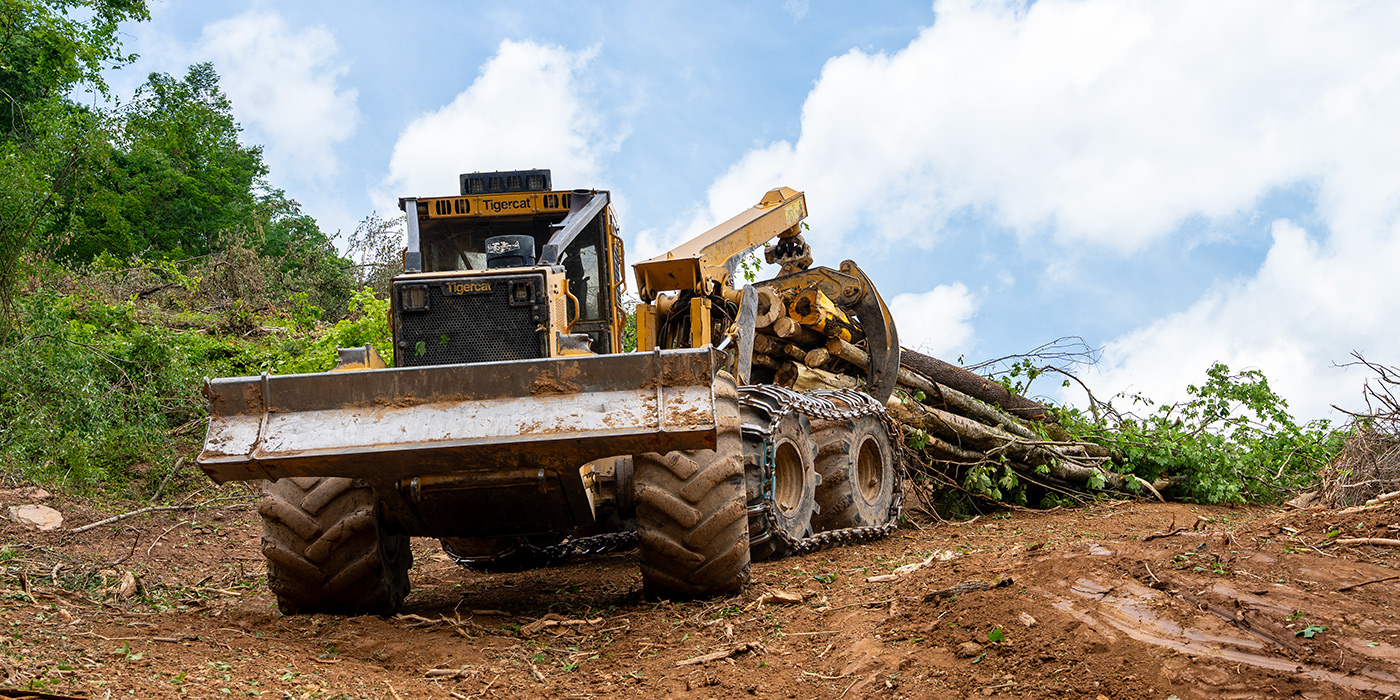
Brad Woodall finds that the 625H really shines when it comes to the steep and rocky ground in his area.
Brad purchased a Tigercat 234B three years ago, switching from a Barko 495. “I was trying to buy just a delimbing trailer from Ricer, so I went down to Lucasville, and I demoed a 234B mainly to try the delimber, and just fell in love with it. The swing torque was a lot better, and it’s built a lot better, so once I ran it, it was hard to give it back.”
It was a similar story when purchasing his skidder last year. “I have always run John Deere skidders, but when it was time to get this last new one, we tried the 648 LII and we didn’t like it. It just didn’t pull well,” says Brad. “So, we demoed a brand new 620H, and then a week later we demoed the 625H, and then we decided on the 625. We were doing a pretty hard skid where we were at — about a mile long — with about half a mile uphill. So, the bogie really shined there.” Brad typically encounters steep terrain on his contracts. “We don't get a whole lot of flat land. And we do get some really steep ground. In this area it's quite rocky, but the bogie handles it well. That's what sold us on the machine.”
L & L Excavating and Land Clearing
The following day we headed west to meet up with Larry Strickland and his son Levi, owners of L & L Excavating and Land Clearing LLC. The crew had just started a 150-acre (60 ha) clear cut contract just north of Charleston.
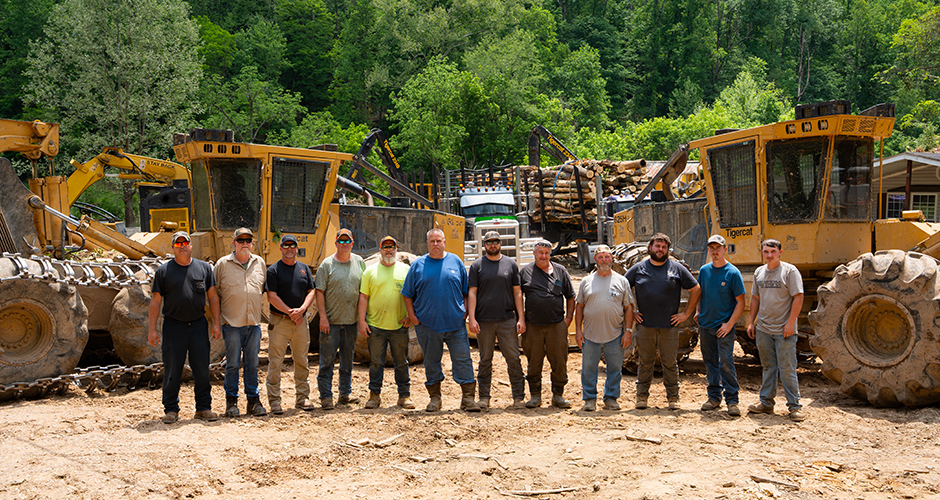
(L-R) Terry Cook; Jerry Smeak, Tigercat District Manager; Troy Sneddon, Ricer Regional Sales Manager; Dan Gamble; Kabin Taylor; Derrick Dunnavant; Steven Dunnavant; Jimmy Cox; Larry Strickland; Levi Strickland; Tyler Swingle; Trevan James.
Larry Strickland began his logging career back in 1978 with an old Deere 440 cable skidder and a Barko loader. Levi started helping his dad when in the woods at age twelve, operating a skidder. “He started running skidders, just working all the time. I told him, if you want to work doing this, you can make a good living because I have all my life,” says Larry.
Larry and Levi are equal partners in the company now and it has grown into a substantial operation. The Tigercat fleet includes five 234B loaders, one T234C track loader, five 625H skidders, and one 632H skidder. The head count of 40 employees includes around eighteen full-time truck drivers. The hauling side consists of about 40 trucks and 70 trailers.
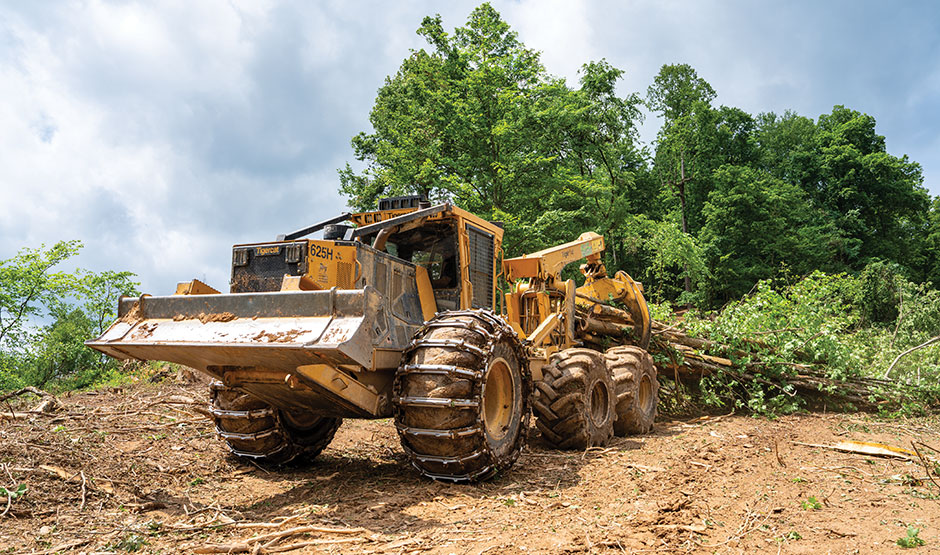
Larry Strickland says the six-wheel skidders have increased climbing performance over four-wheel skidders, and increased utilization in soft soil conditions.
L & L keeps those trucks moving. “We do about 125 loads a week, and that’s 52 weeks a year,” explains Levi who pays special attention to harvesting system balance and flow. “Our theory is that we need those loader booms moving all the time. If your loader is sitting, you’re losing money.” Most of L & L’s product is hauled to the Weyerhaeuser mill near Flatwoods. The company also supplies WestRock, and Larry has a long relationship with Superior Hardwood, hauling sawlogs to the mill for many years.
Up until 2022 Larry had never run a Tigercat skidder. When he decided that the company needed a six-wheel skidder, he called his friend Tom Ricer, President of Ricer Equipment and purchased a 625H, followed by four more. Larry says that the integration of the six-wheel skidders has had a very positive effect on the business. “A good part of that is due to increased utilization. We work a lot more days with those bogie skidders,” he explains. In addition, the climbing performance, especially with traction aids, is well beyond any four-wheel skidder. “With the six-wheel skidders, we don't have to build as many roads. Every road you build in West Virginia, you’ve got to put grass seed, and straw on them afterward.” The 625H reduces the time, expense and environmental impact associated with building and decommissioning skidder roads.
SC & L Construction and Logging
We crossed the state line into the northwestern corner of Maryland to visit Jerry Sisler, owner of SC & L Construction and Logging based in Friendsville. Jerry and his father started the company in 1983 as equal partners, logging mainly in West Virginia, Pennsylvania, and Maryland. Jerry is a fourth-generation logger, and he has his three sons working with him.
The company sells to different mills around the area. “It just depends on who’s paying the most for certain species,” says Jerry. Products include veneer logs, low grade pallet logs and pulpwood. “We'll separate the veneer for the veneer buyers, and then we also have scragg wood, which we sell to pallet mills, and then we sell pulpwood to Weyerhaeuser for OSB. We also sell to Covington in Virginia, to the paper mill down there. We chip all the tops, which go to Kingsford for charcoal.”
(L-R) Troy Sneddon, Ricer Regional Sales Manager; Jerry Smeak, Tigercat District Manager; Jerry Sisler; Casey Sisler; Jeff Bolyard.
Jerry purchased his first Tigercat machines — a 244 loader and a 620D skidder — back in 2002. The current fleet includes 610E, 630E and 635G skidders, a recently purchased 250D loader, and the original 244 loader. “We got started with the 244 and 620D, and then after that we just knew. We realized how good the factory is if you have a problem. It's just amazing.”
Jerry mainly runs the 610 on smaller jobs and thinning applications. For mountain logging he emphasizes the extreme performance difference between a four-wheel and a six-wheel skidder. “We run them together and the four-wheel skidder, the 630, which is a big skidder — it will only take maybe a third of what the bogie will pull uphill in slick conditions.”
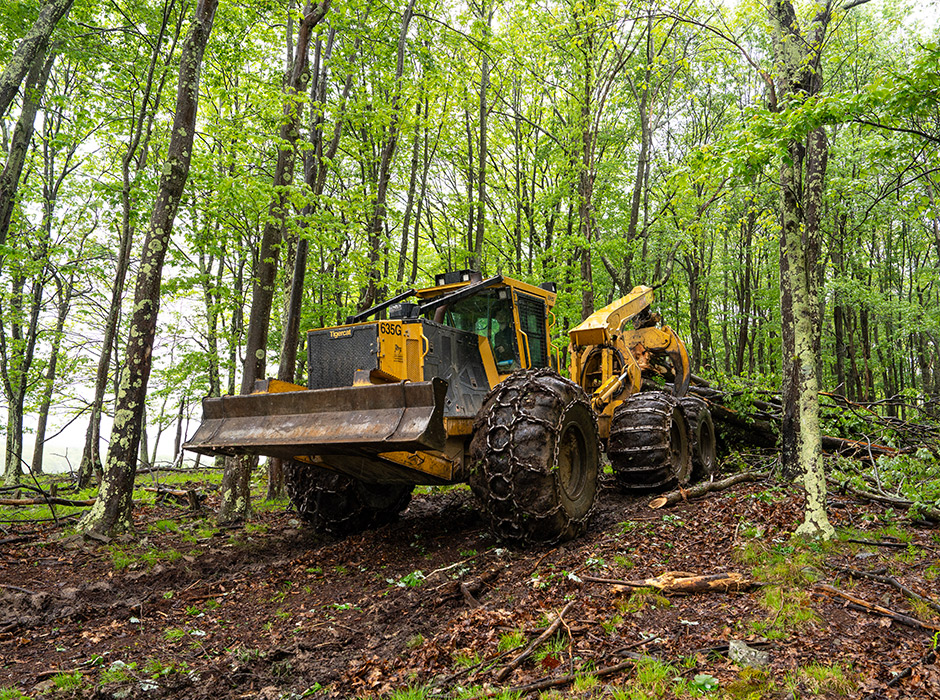
Jerry Sisler uses the 635G to handle bigger payloads, especially in wet conditions.
Jerry continues, “In 2014 when we started chipping, we realized that we needed something that could bring a bigger payload, especially in these wet conditions. Then of course with the bogies you don’t rut up like you do with the four-wheel skidders. If you hit a log or something, the back wheels will spin out on a four-wheel skidder. The bogie will just keep on going. I bought my very first bogie, a 635E, in 2014, but I demoed one in 2000. Looking back, I would have been way ahead if I'd have bought that [six-wheel] skidder then because there's just no comparison on what it will pull in slick or hilly conditions when you have trouble with traction.”