Industry champion, Stephanie Fuller Johnson is strengthening the next-generation forestry and logging workforce in Alabama and beyond through her work with the Forest Workforce Training Institute, a nonprofit launched by the state’s Forestry Association.
— Samantha Paul
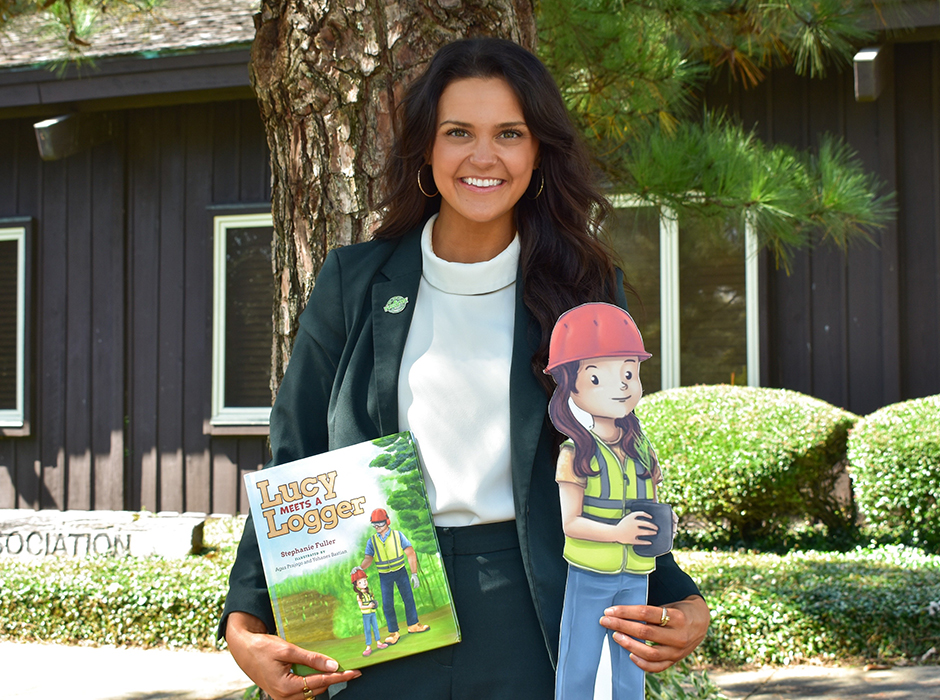
Stephanie Fuller, Director of Promotions and Economic Development for ForestryWorks and author of Lucy Meets a Logger.
Long before she ever stepped into a workforce development role, Stephanie Fuller Johnson was already immersed in forestry. She grew up in a multigenerational logging family in Lanett, Alabama, where forestry was less a career choice than a way of life. “Our lives revolved around it. My dad was up with the sun and didn’t come home until it went down; long, demanding days that showed his commitment to the work. I remember how close his crew was. They felt like an extension of our family. Spending time in the woods, seeing their respect for the land and the trees they harvested, left a lasting impression on me. It was an incredible childhood, and I wouldn’t trade it for anything.”
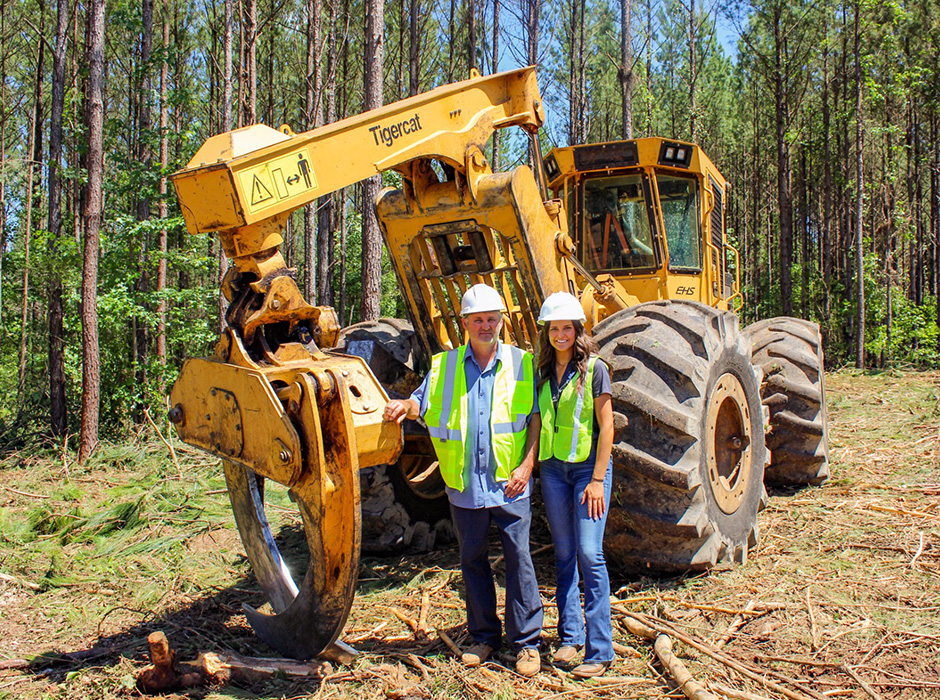
Her family’s involvement in logging stretches back four generations, a legacy Stephanie and other family members continue to pass forward. Two of her four brothers-in-law work in forestry. Stephanie’s husband is a forester, and one sister co-owns a logging company. “We’re kind of tag-teaming it,” she says of her family’s shared career path. Her father, Todd Fuller, spent roughly four decades in the woods. He ran a small but highly productive operation with a Tigercat buncher, skidder and loader. He was known for his strong preference for Tigercat machines. “When I got my first car in high school, I proudly had a metal Tigercat license tag on the front of it,” she recalls. The Fuller’s Logging crew had nine employees and regularly moved between 90 and 100 loads (over 2,500 tons) of wood per week, an impressive output for a small outfit.
The woods are not simply a jobsite, but a viable and lasting career path.
— Stephanie Fuller Johnson, ForestryWorks
Each summer, forestry students from Auburn University visited her dad’s jobsite to observe harvesting firsthand. Watching them learn and seeing her father treated as a role model stayed with her. Those early experiences shaped how she saw the forestry industry. Despite her upbringing, Stephanie didn’t initially plan to work directly in forestry. In college, she studied economics with the intention of pursuing rural economic development. She knew she wanted to support the types of communities she grew up in, places where forestry drives local prosperity.
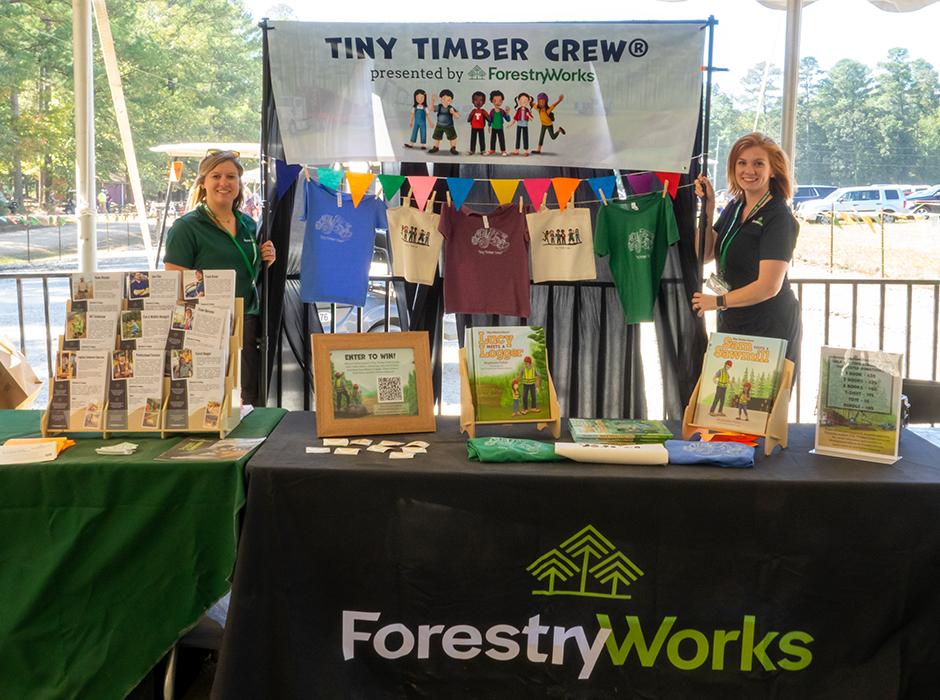
Part of the ForestryWorks booth at the Mid-South Forestry Equipment Show, October 2025.
Creating pathways
Stephanie’s path into forestry workforce development came through a chance meeting just before graduation in January 2019. At an inaugural reception, she connected with the Forest Workforce Training Institute’s President, Chris Isaacson, a moment she describes as an instant fit that aligned her passion for rural development with a direct role supporting the forest industry.
She joined the Forest Workforce Training Institute in 2019, when it was still in its infancy. The nonprofit was created by the Alabama Forestry Association after industry leaders recognized a critical gap — no state or national level organization existed that was dedicated specifically to recruiting and developing talent for forest industry careers. “Loggers, sawmill operators, paper producers, and landowners all agreed that workforce development required specialized attention because forestry is a uniquely complex sector with distinct training needs,” she explains. The Institute, often branded publicly as ForestryWorks, was designed to fill that gap.
Stephanie’s initial role was straightforward but demanding with boots-on-the-ground outreach. She travelled to schools and career events across Alabama introducing K-12 students to forestry careers and helping them understand what modern logging and forest management looks like.
Then 2020 changed everything. When in-person visits shut down, the organization faced a stark reality. Its primary outreach model had vanished overnight. The disruption forced them to rethink communications strategy, develop digital resources, and invest in online marketing and educational tools. The result was eye-opening. Stephanie says, “It made us really think. Are we effectively reaching everybody that we can reach and how are we communicating with these people?” Online communication significantly expanded ForestryWorks’ reach beyond state borders, allowing the organization to connect with students, educators, and industry partners nationwide. By the end of 2020 and into 2021, Stephanie was helping develop national partnerships and programs across multiple states.
A proud moment: Stephanie and her father with their trusted Tigercat skidder.
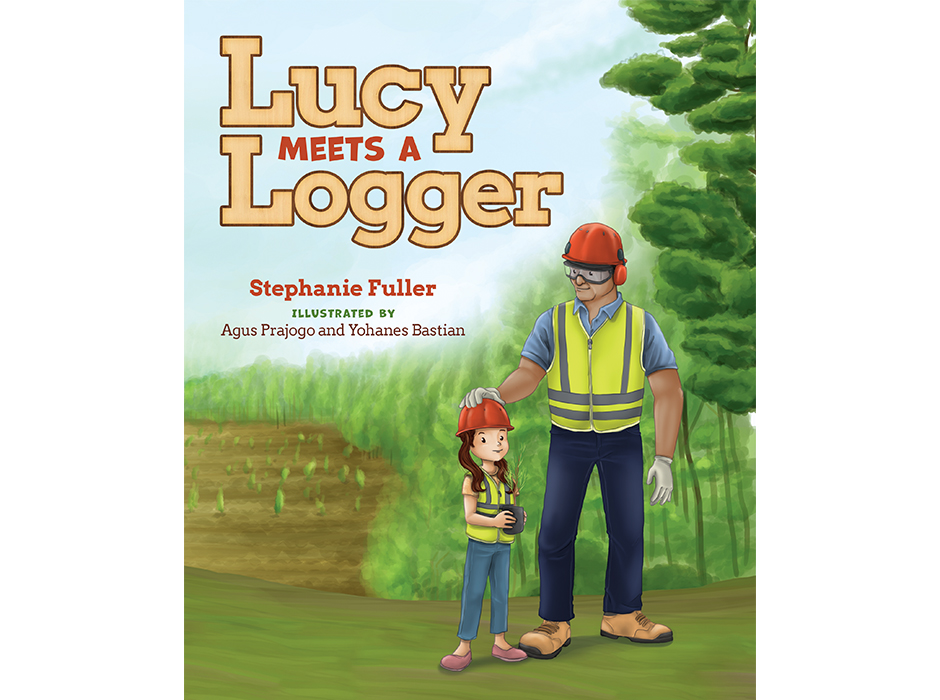
One exciting resource to emerge in 2020 was a book that Stephanie authored. Lucy Meets a Logger, is the first title in what has since grown into the Tiny Timber Crew children's book series. The idea was simple but purposeful; introduce young students to an industry they rarely see firsthand, explain how sustainable forestry works, and show the wide range of careers on offer. “Many children may spot a log truck on the highway, but they don’t see what happens in the forest, or the people behind that work. You can’t be, what you can’t see,” Stephanie believes. “That is why it is so important to get the exposure to the younger generation early on.” Stephanie modelled Lucy after herself, while Mr. Logger was inspired by her father. Her hope was that other children, especially girls, could see Lucy and think, I could do that too.
The books also filled an unexpected need during a time when in-person classroom visits weren’t possible. Parents and teachers could still introduce students to forestry through storytelling, helping them understand concepts like sustainable forest management in an accessible way. “The response to the book has been overwhelmingly positive, and I am humbled by the support it has received,” Stephanie says. With few children’s books portraying the full picture of sustainable forestry, the series quickly gained support, with over 6,000 copies sold and hundreds more donated to school systems across the United States each year.
Following Lucy Meets a Logger, the series expanded to showcase other parts of the industry. New stories follow characters visiting tree farms, sawmills, pulp mills, and more. Each member of the Tiny Timber Crew discovers a different job, reinforcing the larger goal of the series — to provide engaging resources that share an accurate story of sustainable forestry and introduce young readers to career paths they might never otherwise encounter.
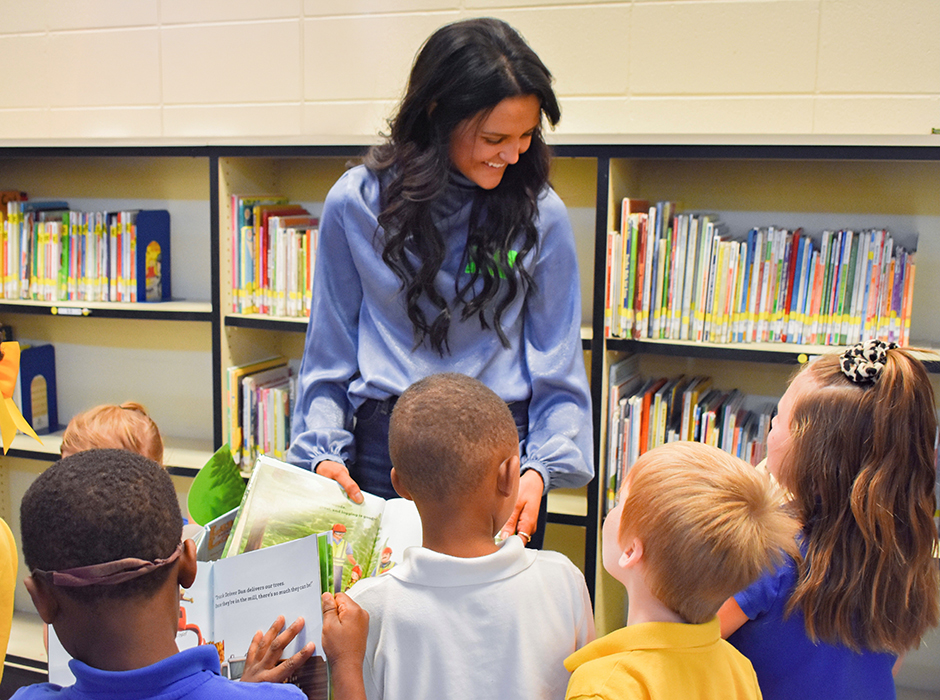
Stephanie engaging elementary students during a reading session in Brewton, Alabama.
Stephanie describes the approach concisely as, “A national program with a local focus.” The organization produces materials and resources for students in both English and Spanish, so children from diverse backgrounds can see their families’ work represented. In some regions, for example, Hispanic workers make up a significant portion of forestry crews and mill labour. Providing educational content in their language helps families understand and take pride in those careers.
Stephanie spends time reading to students and speaking at schools, where questions can be unpredictable but insightful. Children, she notes, often challenge speakers more than adults do, pushing her to explain forestry concepts in simple and engaging ways. “It's fun seeing a light bulb go off on a young student when they learn toilet paper comes from trees.”
National program, local focus
From the beginning, leaders behind ForestryWorks suspected their workforce challenges weren’t unique to Alabama. Timber products move across state lines daily, and labour shortages or skills gaps in one region often mirror those elsewhere. By 2020, that assumption proved correct. The organization began expanding outward, using Alabama as a testing ground for new programs before adapting them for other regions.
The model is deliberately flexible. Forestry conditions vary dramatically by geography from year-round logging in the south to highly seasonal operations in northern states. That means workforce initiatives must be customizable rather than standardized. Instead of imposing a one-size-fits-all template, ForestryWorks collaborates with local partners such as state forestry associations, universities, and government agencies to tailor programs to regional needs.
Sustaining forests and careers
“The forest industry offers a wide range of career paths suited to different interests and education levels,” says Stephanie. “Opportunities exist for individuals entering the workforce with a high school diploma who want hands-on, technical training, as well as for those pursuing engineering degrees or other post-secondary credentials. Exposing students to this breadth of options is essential if they are to see forestry as a career path.”
The impact of these efforts is evident in the stories emerging from schools across the country. Students who completed the ForestryWorks Forest Worker Certificate Program have gone on to secure summer internships with foresters and are now preparing to enter forestry programs at the post-secondary level. The Sawmill Worker Certificate Program produced similar results. “After touring a sawmill, four students from a single graduating class applied for positions at that facility after graduation.” These outcomes can be attributed to a clearer understanding of the career opportunities available.
Many children may spot a log truck on the highway, but they don’t see what happens in the forest, or the people behind that work. You can’t be, what you can’t see.
— Stephanie Fuller Johnson
In Alabama, a free four-week summer Logging Equipment Operator Training School provides participants with foundational skills to join a logging crew. The program has consistently achieved a high rate of job offers for graduates. Career progression is tangible with former students advancing from entry-level operator positions to crew foreman. As fewer logging companies are passed down from one generation to the next, more newcomers have the chance to move into leadership positions and even become owners.
Stephanie tells students all the time, “It’s in our collective interest to be responsible stewards of the land and to protect the sustainability of the supply chain. If we fail to care for the forests we depend on, we undermine the very foundation of our work. Without responsible management, there is no long-term future for the industry, and no jobs ten years from now.”
Stephanie adds, “Harvesting trees isn’t the end of the story, it’s part of a cycle. In many regions of the United States, two or three seedlings are planted for every tree harvested, ensuring future supply while maintaining healthy forests. That cycle also plays a role in climate change. Trees absorb carbon as they grow, and when wood is turned into products — lumber, paper, or building materials — that carbon remains stored for the life of those products. Understanding that system is critical, not just for public awareness, but for attracting the next generation of forestry professionals.”
Despite rapid growth and national reach, ForestryWorks’ mission is simple: support today’s forest industry while preparing tomorrow’s workforce. It is a goal grounded in Stephanie’s own experience, shaped by family, and an early understanding of the role forests played in her life long before she chose to work in them. “The woods are not simply a jobsite, but a viable and lasting career path.” Through Stephanie’s work with ForestryWorks, the next generation of forestry professionals will find their way into the industry much as she did — through direct exposure and a clear understanding of what the industry offers. “My father probably wishes that back when he started his company there were organizations like ours that focused on these efforts. I think he is happy to see that the next generation is going to be supported in this way.”