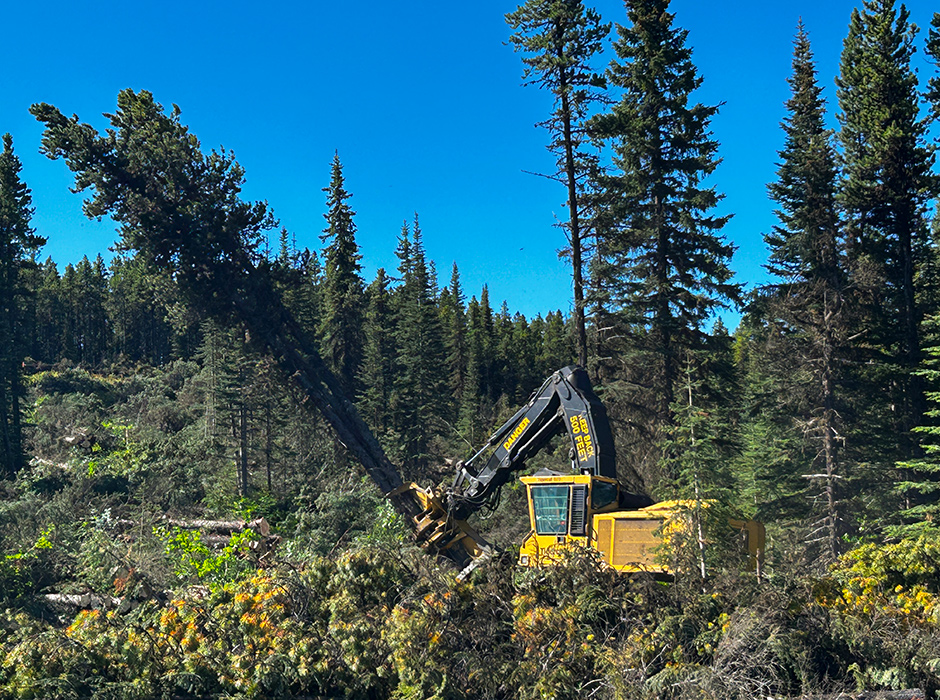
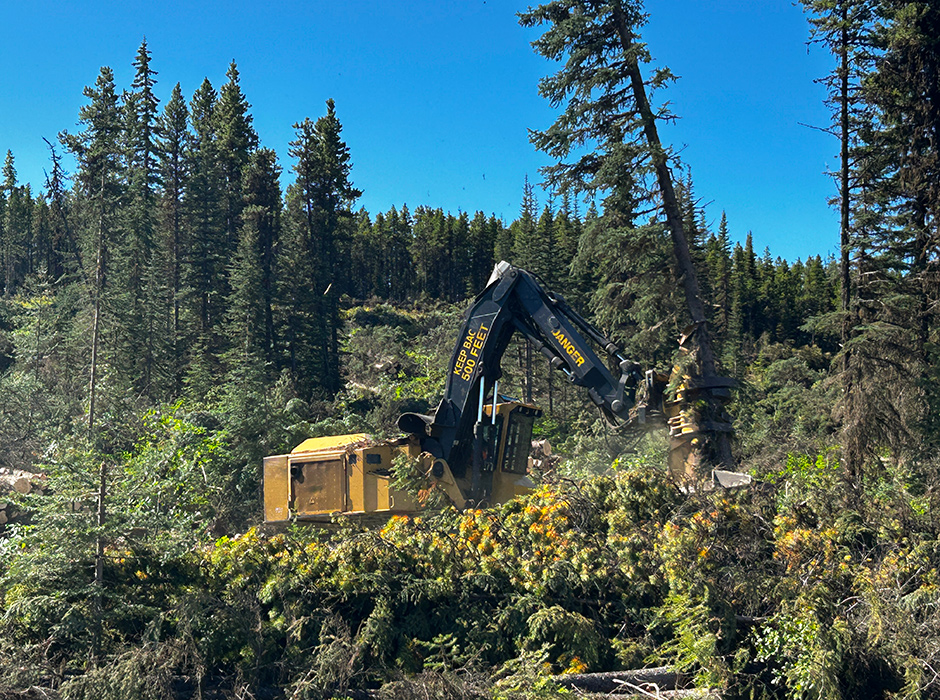
Owner-operator Robby Major has been subcontracting his bunching services in the Peace River region of northeastern British Columbia for over 30 years. Since 2003, he has relied on a single machine, a Tigercat L870 feller buncher.
— Paul Iarocci
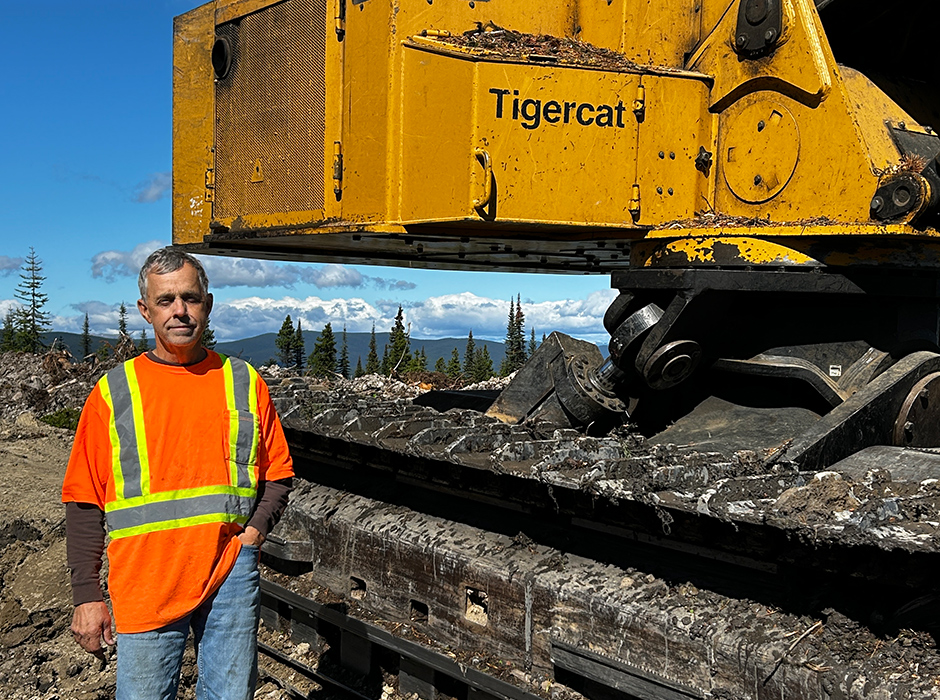
Robby Major alongside his Tigercat machine.
R. Major Logging is owned by Robby and Tracy Major. They live in the small northeastern British Columbia town of Progress on a quarter-section hobby farm. Born in Dawson Creek, his family relocated to Vancouver Island, where he grew up. Robby moved to Chetwynd when he was fifteen. He quit school halfway through tenth grade, and by age sixteen, he was working in the bush.
“I started working for a guy named Glen Bedell who was logging for Canfor,” recalls Robby. “It was a typical first job.” Robby progressed from hand bucking logs to operating a skidder. Eventually he moved on to a log loader. By the time he turned nineteen, Robby had obtained his Class 1 licence. “I started driving truck and hauled logs for about ten years.”
Around 1994, Robby purchased a second-hand Case feller buncher equipped with a rudimentary shear head from his brother-in-law and began working as a subcontractor. Later on, he had a discussion with a neighbour, Brian Young, owner of Young’s Mills who offered to take him on as a subcontractor. It gave him the confidence to upgrade to a Timberjack 618. Robby contracted for him for over twenty years from 1997 to 2018. “Brian was the biggest logger for Canfor at the time.” These days, Robby is working for Hi-Sky, West Fraser’s biggest contractor.
Shayne Waldie, owner of Hi-Sky Enterprises Ltd. cuts 480 000 cubic metres annually for West Fraser, Canfor and Louisiana Pacific. Shayne is an innovator, running a combination of cut-to-length and full-tree systems. With up to six logging sides, Shayne deploys a broad mix of machinery to optimize his contracts and crew. Due to challenging terrain and limited decking and roadside processing space, the crews often run a feller buncher ahead of an infield processor and forwarder. Shayne also utilizes a Tigercat 635H swing boom skidder. He likes the steep slope performance as well as the ability of the machine to manoeuvre loads in selective felling compartments with less damage to the remaining stand.
Robby is currently working the machine about 50 hours per week, eight to nine months out of the year.
Hi-Sky hauls its own timber and Shayne additionally maintains a fleet of coal haul trucks that service the area’s mines. When both businesses are running near capacity, Hi-Sky employs up to 300 people. R. Major Logging is the company’s only subcontractor.
Robby purchased the first 618 in 1997 and acquired a second unit at auction a couple years later. “I had two bunchers and one guy working for me. I ran that way until 2003,” Robby explains. “By that time, I was falling for a yarder and getting tired of looking up and down, falling the steep ground with a flat-bottomed machine. I was working all the time, running one feller buncher and doing all the service and maintenance work on both.” One day he received a call from Glenn Pope, a salesman at Inland. He explained to Robby that he had a Tigercat L870 feller buncher sitting on the lot and invited Robby to have a look.
Next, Glenn offered to bring the machine to the bush the following week for a trial. “I got on and started cutting trees with it. Of course I liked it, and Glenn took both of my 618 machines on trade. I got a good trade value and I had enough downpayment that I was able to just run it myself. I didn't have to double-shift it with a second operator.”
The L870 was larger, heavier and slower than the 618 bunchers it replaced. However, according to Robby, the difference in climbing ability and stability was like day and night. He could confidently work over the side of the machine in bad terrain. He could walk uphill carrying a twenty-inch-diameter tree. He no longer struggled to climb and crest an embankment onto the road at the end of the day. The comfort of the leveling base was a major improvement. Robby had simplified his life and business.
Four years later, the machine was paid for and still in pretty good shape. Robby kept plugging along as the years passed, doing most of his own repair work. He continued to make a good living with his Tigercat machine.
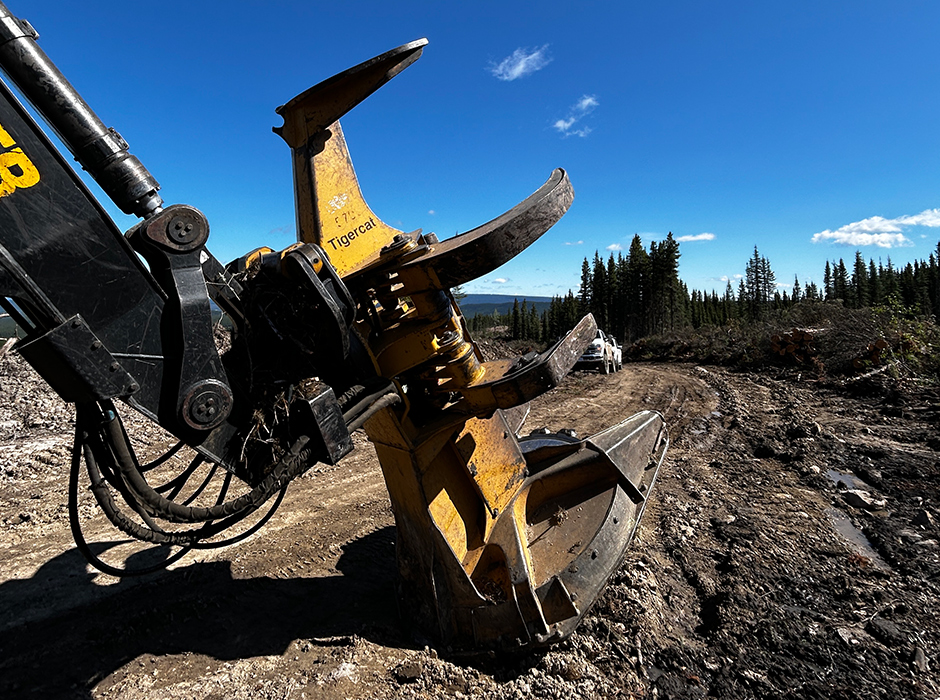
The structure of the 5702 felling head is completely original.
Last year Robby started with Hi-Sky, primarily working on clear fells with leave trees, as he describes it. He cuts to a prescription with the aid of GPS in the cab. The prescription specifies the percentage of leave trees per size and species. The map identifies pipeline crossings and designated wildlife patches.
He is currently working on a crew with one other feller buncher. Shayne’s employees run newer machines, but Robby easily maintains the required production with his aging L870. “I’m never worried about Robby,” Shayne admits. “First of all, it’s a Tigercat. And second, he’s a really good mechanic and a really good operator with very steady production.”
The machine has now surpassed 30,000 hours. How does an owner-operator maintain high uptime on a twenty-three-year-old machine? First, Robby is meticulous with maintenance. “I service it after work and usually on weekends. I log everything in my maintenance book. Last year, I had virtually zero downtime. That's how crazy it is.” He keeps an inventory of spare parts in his shop, including main boom and stick cylinders and a grab arm cylinder for the head.
Robby considers it is an advantage to own an older, simpler machine. He concedes the electronics are getting better and more reliable on new iron “but I don't have to worry about being down for three days because of a ten-dollar sensor because I don't have any sensors. The only electronic thing really is my speed sensor for the anti-stall, and it's never given me any trouble.”
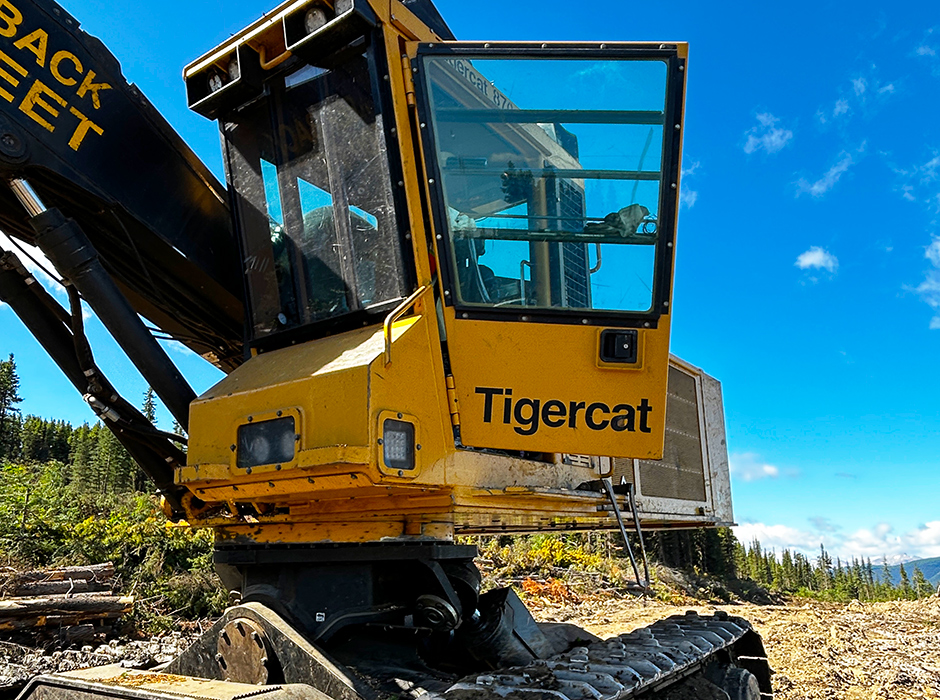
Robby’s L870 at over 30,000 hours is an extremely reliable, high uptime machine.
Robby’s familiarity is also a big advantage. “I've crawled over every part of it,” he says. Robby is so in tune with his machine, he can hear and even smell emerging issues like a dripping hydraulic hose. He once heard an unfamiliar sound that soon led him to the cooling fan. “After several thousand hours, the fan bearing was weak, so I just stopped and ripped it apart. Some operators wouldn't have noticed that. And I've seen what happens when that fan comes off. It's never good. It goes from a $250 part to thousands of dollars of repair work.”
He has a strict warm-up and cool down routine. In winter he covers the rad to build heat and warms the machine up slowly, keeping a close eye on the gauges. Then he cuts a few trees at 1,500 rpm to let everything loosen up before opening it up. “I cool it down slow as well. I just take care of it.” He also leverages the documentation available to him. “They tell you a lot in the book,” he says. “I've got the operator's manual, the service manual, the engine manual and the hose book. Being organized helps a lot. It's not that hard with one machine. It's a lot of work and long hours, but I mean, it's my job. If you look after it, it looks after you.”
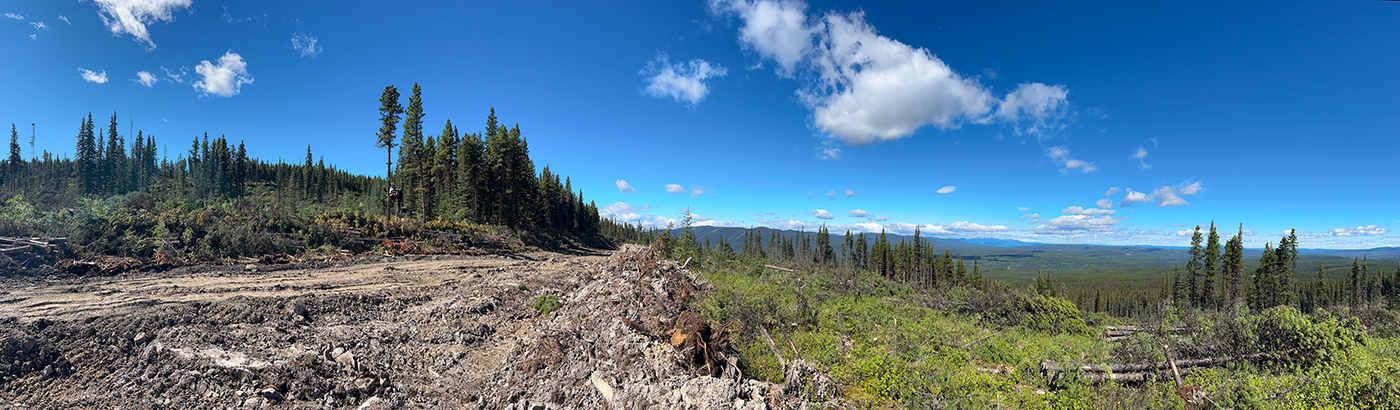
Most of the blocks are clear fells with some residual standing timber. The prescriptions define wildlife habitat areas as well as size and species specifications.
He is very mindful of the gauges. “I run a 150 °F maximum on the hydraulic temperature and I keep the engine running cool, no matter what. My machine doesn’t have a reversible fan, which I don’t mind. I like getting out and stretching a little bit anyway, so I just get out and clean the screen a couple times a day. I have a compressor in the back of the truck. Once a week, I blow the dust out of it. If it starts running hot, I stop and figure out what the problem is.” He rarely experiences O-ring or hose issues.
Spring break-up in the northeast part of the province generally spans three months but depending on the weather has lasted up to five. “We have a little acreage in Arizona. We team rope, so we take horses down with us. April in this Peace River area is not a great month for weather. It's my favourite time to go away on holidays. I have cameras at home on my place. I just keep watching until the snow is gone. Then I come home.” After a well-deserved holiday, Robby starts his annual maintenance routine.
“First, I take all the guards off it and clean it all out. It takes about two days. I clean every last stick out of it, before I even go near it with a washer. Every couple years, I'll take the rad right out of it and hang it on a chain.” Then he starts on the big jobs, leaning on Inland’s service expertise when required.
“Chris Stubbs is a great mechanic at Inland. When I’ve got something that I need a hand with I try to get him, but like I said, I don't use them too often. This year I split the tracks because both my track tensioners were leaking. I pulled the idlers and track tensioners out, took them to Prince George, had them chromed, and put them back together.” While the tracks were off, Chris helped Robby pull the travel motors and replace the brakes. “Then I put the tracks back together myself, welded them up and tightened them. That's the kind of thing I do.”
Over the life of the machine, the Cummins 6CT 8.3 L engine has been replaced twice. The saw pump and motor have only been replaced once, a job that Robby completed on his own. The undercarriage has been rebuilt twice, and the carrier is on its third main pump. He recalls cutting right-of-way on a steep hill way back in the bush when the main pump failed. “I had to get an excavator in and build a trail for my pickup. I got my come-along out there, drained the hydraulic oil into a barrel, got the pump out, and changed it. That’s just what you do when you're in the bush. I had Stubbs come up for that. He set it all up real nice, and it's probably the best the machine has ever run.”
Robby says that in general, access to most components, hoses and service points is quite good. “The worst thing is the track hoses. I've changed them several times over the years. And in the wintertime, when it's frozen cold, that's a pretty much a full one-day job because of all that mud and debris freezing in there. On the newer undercarriages, they come up the back and are easy to get at. On the other hand, mine go a long time because they're tucked away and protected.”
Structurally the machine has been very sound; no cracks in the undercarriage and just a couple of small plates on the stick boom. Everything on the 5702 head is original with just a small weld on the butt plate and a repair on the wrist.
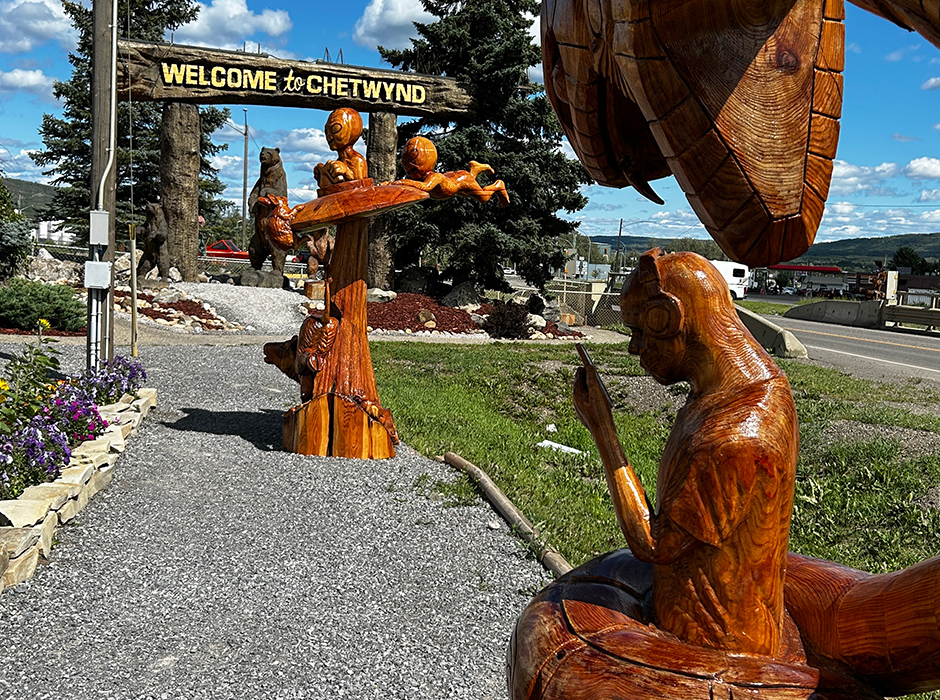
Hi-Sky Enterprises is based in Chetwynd, BC. The town hosts an annual international invitation-only chainsaw carving contest every June. The carvings are displayed throughout the town. Each year twelve carvers start out with an eight foot 40 to 50 inch diameter western red cedar log. They have 35 hours to complete the sculpture. The results are stunning.
The machine was equipped with a tree counter but it stopped working a long time ago. “2,000 to 2,500 trees used to be pretty common for me. I would cut for twelve hours, especially when I had payments.” At age 65, Robby doesn't cut the same volume or work as many hours. However, he still puts in ten hours. Factoring in maintenance and travel time, it amounts to a fifteen-hour day.
Robby appreciates the way that Shayne runs the operations. “He is great to work for because he will cut right to the end of the season, knowing that if they can’t get all the wood out, the loading and hauling will be the first operation to start back up in the summer.” It extends the season a little further into spring and makes the next startup flow better, keeping everyone busier. “He's a smart logger. He can start hauling that wood out before the crew starts working. Even if it's not processed, the processors can come in early because they can work on the road. Then when we get back bunching a new block, they're not all waiting on us. Everyone has something to do.”