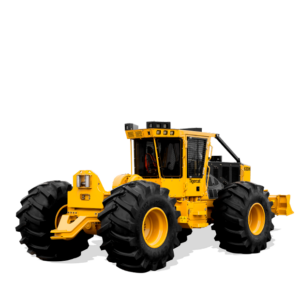
Tigercat Industries collaborates with Weyerhaeuser team in Edson, Alberta to improve mill yard workflow and efficiency.
— Paul Iarocci
The 632H can pull 42 tonnes, a 25-30% yard production increase. Consuming 11-12 L/hr, it has cut fuel costs nearly in half.
Weyerhaeuser’s Edson, Alberta mill facility inputs primarily aspen logs and manufactures oriented strand board (OSB). At 43 years, it is the oldest OSB mill in Canada, operating around the clock on four twelve-hour shifts.
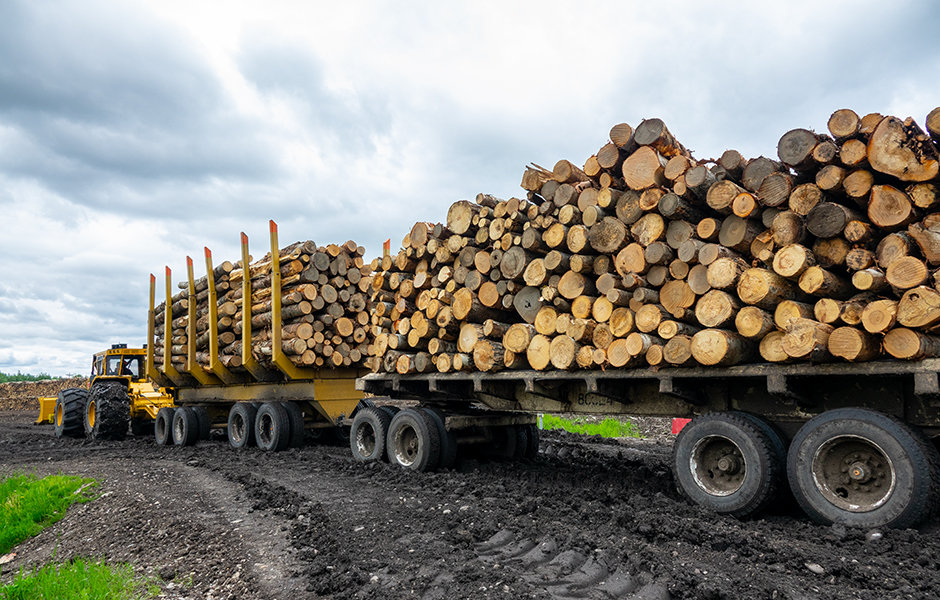
The mill yard operation involves unloading eight-foot logs from B-train haul trucks with large track-based log loaders. The mill maintains a sizable log inventory. “We offload the logs and stack them in decks anywhere from five to seven metres high,” explains Log Yard Department Lead, Murry Hellekson. Until recently, most of the mill intake has been fed by agriculture tractors pulling wagons that are loaded from log yard inventory. “Other than what we directly offload from the trucks during the dayshift, at least twelve to eighteen hours every day the intake is strictly supplied by the wagons,” says Murry.
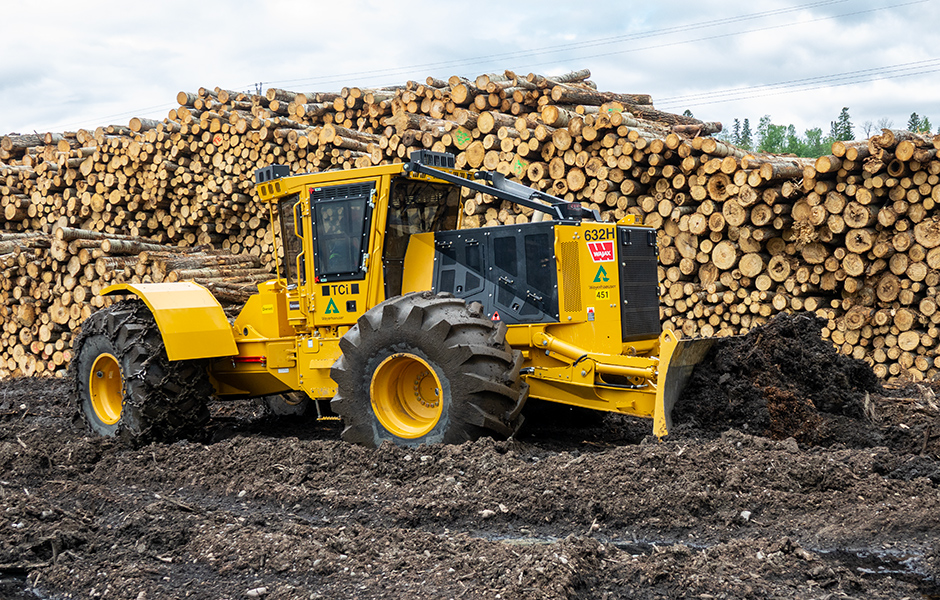
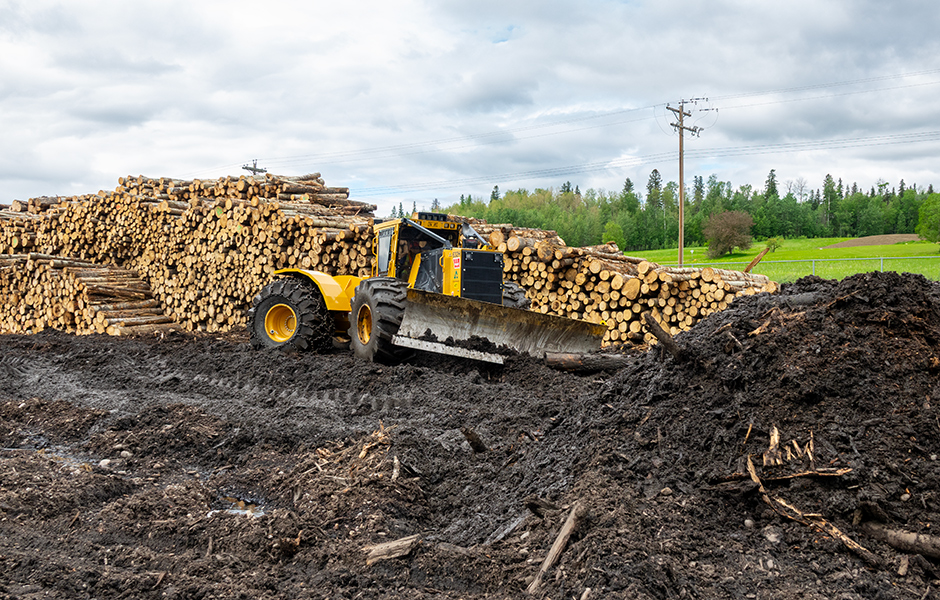
Reclaiming decks in this type of ground condition previously required that the company contract a D6 dozer or excavator. Log Yard Department Lead, Murry Hellekson estimates 80% of the work can now be done with the TCi carrier.
Two other important tasks in the log yard are road maintenance and deck reclaiming. “After we've removed our inventory, we have to clean up the log debris, brush and mud,” Murry says. “Our decks are about fifteen metres wide and up to a couple hundred metres in length. We push the material, without crossing roads, from one end to the other to reclaim the top surface. It's a messy job.” It's usually wet, because spring is when the major cleanup comes.
The yard operates with a three-person shift — two loader operators, and one on the log forwarding machine which shuttles back and forth constantly except when the trucks come in, or during maintenance detail. Murry explains that these windows allow for yard grading duties, along with additional tasks, like snow clearing in winter, and dust control in summer.
The challenge
For many years, the log forwarding operation was accomplished with the use of high horsepower agriculture tractors equipped with a silage-style blade. The bulk of the yard maintenance work was accomplished by bringing in dozers and graders on a contract basis. This system had several shortcomings. The ag tractors had issues with durability and mechanical reliability, and the fuel consumption was heavy. Limitations in the blade design, including the profile and clearance, made the machines difficult to rely on to assist with yard maintenance. “Our decks weren't always getting done because we didn't have the right machine for the job,” Murry adds.
Tigercat came to us and said they could give us a 632 with a six-way dozer blade. And that was a game changer for us.
— Jody Muldoon, Maintenance Manager
As Maintenance Manager Jody Muldoon explains, “The challenge given to me was to find a more fuel-efficient machine that can do more and pull more wood, so that we're doing less trips and using less fuel. We also wanted a more reliable machine. We had considered using a skidder and thought if it had a six-way dozer blade, it could replace what we hire a grader and a dozer for.”
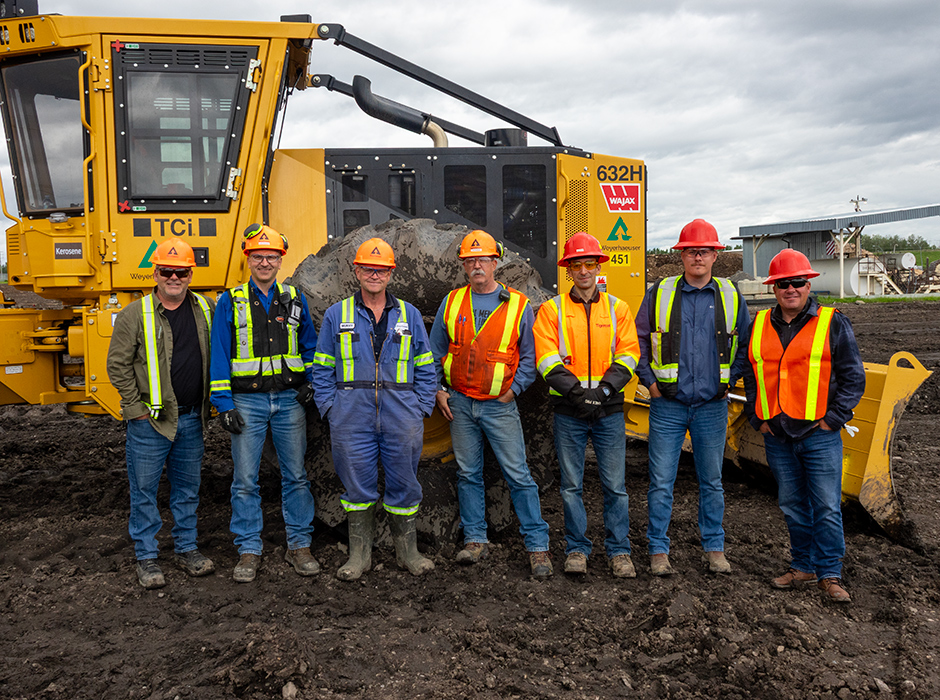
Team effort. (L-R) Jamie Forsey, Green End Coordinator / Log Yard Supervisor; Jody Muldoon, Maintenance Manager; Murry Hellekson, Log Yard Department Lead; Len Parker, Operations Manager; Clint Andrea, Wajax Sales Specialist; Alex Farquhar, Wajax Product Support Representative; James Farquhar, District Manager Tigercat Industries.
In the 1990s, Jody ran logging equipment. “I worked for seven years out in the cut blocks, running skidder and delimber — feeding this mill actually. And I have good friends who are still contractors who feed this mill, and a lot of those contractors run Tigercat equipment today. So, I'd seen the reliability record of Tigercat over the last 30 years, and I have nothing but good things to say. It’s durable, reliable logging equipment. So, when this project came about, Tigercat obviously came to mind.”
Maintenance Supervisor, Ryan Norrish, and Log Yard Supervisor Jamie Forsey worked with Murry and the log yard crew, asking what they wanted out of a new forwarder. Then he reached out to Wajax to explain the requirements. “And that's when Tigercat came to us and said they could give us a 632 with a six-way dozer blade. And that was a game changer for us. Ryan worked with Tigercat and was instrumental in getting the design that we needed,” says Jody.
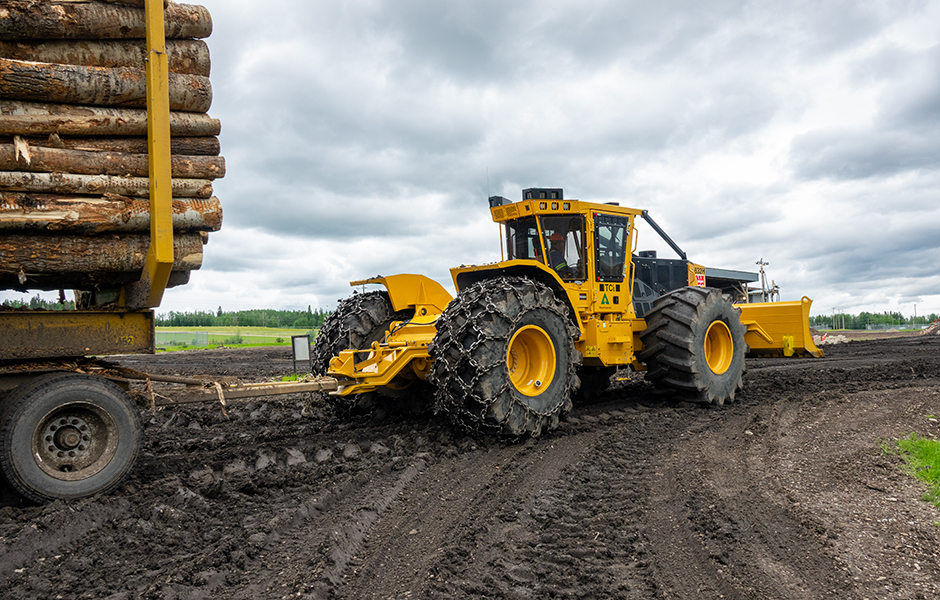
Aside from the blade, the other important customization was the development of the hitch. “We use a pintle hitch system with a hydraulically operated pin on the forwarder so that we don't have anybody standing in between the trailer and the forwarder,” Jody explains. “The operator can back up, actuate the pin with the hydraulics, and take off. There's no risk or hazard of getting pinched.”
The pintle hitch system is hydraulically actuated. Tigercat Industries custom developed this with the Weyerhaeuser team. “The operator can back up, actuate the pin with the hydraulics, and take off. There's no risk or hazard,” says Maintenance Manager Jody Muldoon.
Jody characterizes the development process as transparent and efficient, with clear communication. Online meetings and 3D modelling allowed Ryan, Jody and the rest of the team at Weyerhaeuser to validate the design at multiple stages in real time. “It was really easy for us to work with them on the design, because we could visually see what they were presenting to us,” says Jody.
The result
The yard crews are piling hours on the TCi 632H carrier. In the first three months of operation, the machine acquired 1,500 hours. It's been running eighteen hours a day on average, every day. With far less engine horsepower than the ag tractor it replaced (285 vs 500), the 632H is accomplishing more. It can pull two trailers with a total weight of about 42 tonnes. Consequently, yard production has increased 25-30%. The real kicker is the fuel economy. “It pulls stronger and the fuel economy is way better than we expected. We are actually using almost 50% less fuel,” Jody reports.
The functionality of the six-way blade has greatly reduced the reliance on dozers and excavators for deck reclamation. Murry estimates that 80% of the work that was previously contracted out can now be accomplished in-house with the 632H.
Murry and Jody say that they are discovering other unanticipated benefits. One example is the back-blading ability of the machine. The blade design and profile are better suited to the back-blade function compared to the ag tractors, and the blade clearance is more than double. “It's just a finer way to tune what you're blading, because when you blade frontwards, you leave ruts behind you. When you back blade, your watershed is better, everything is better. The clearance is so much more. Even if I'm back blading over a bunch of mud, I can at least level it out to where it will drain water,” explains Murry.
He adds that the ability to turn the seat around is a benefit, especially when reclaiming a pad. “Instead of turning around, you just spin your seat around and you can go as fast backwards as you did forwards. When you reverse the seat, the controls reverse on the joystick. It's very intuitive.”
It pulls stronger and the fuel economy is way better than we expected. We are actually using almost 50% less fuel.
— Jody Muldoon
The mill has a high degree of reliance on the single TCi machine — it is feeding the log intake and maintaining the yard. Jody emphasizes the importance of uptime and after sale support. “The support was another part of our consideration,” Jody says. “What kind of after purchase support are we going to get? Because reliability is key. If that machine is down, the mill isn't getting fed and it shuts down. That's a huge cost to us. We have access to engine diagnostics and can log in and work with this equipment, including directly with the Wajax technicians. Getting quick support is huge for us, and Wajax has been really good.”
Jody sums up by stating that the entire development and procurement process as well as the startup and initial results have all been very positive. “We will definitely be sharing this concept with the rest of our mills.”
Tigercat H-series skidders are available with an optional six-way blade for added versatility in the forest. In addition to standard skidder duties, expand the use of your machine with the ability to build and grade roads, clean out ditches, plow snow and move materials and debris off to the side and out of the way with less machine movement.